

Lost in the past. Stories of people and places.


The Farm by the Loch #Nostalgia
A while ago I reminisced about my childhood holidays on my grandfather and my uncles' farms in Scotland. Here are some more photos of times passed. They were taken in the late 1940s before I was born, but I remember the stooks of corn made at harvest time.


After the corn had been cut a bundle of sheaves were tied with a strand of corn and propped up with the ear upwards to keep it off the ground until all was collected for threshing.


Haystacks were thatched to keep the rain out.

A new lamb is always valued.

My grandmother with Dick and Dora.

Lewis Waller and Florence West, a couple of Victorian actors

I discovered the show business couple
of Florence West and Lewis Waller thanks to a postcard posted on Twitter by MissHistoryGal. Starting their careers a little earlier than
the Edwardian actors I usually research I hadn’t been aware of their interesting
lives.

Florence Isabella Brandon was born in
Chiswick in December 1859, the eldest daughter of Horatio Brandon a successful
solicitor. She had 6 sisters and 2 brothers. She was a keen amateur actress who
decided to write to the famous comedian J L Toole to ask for employment with
his theatrical company. Having convinced him that she was a serious actress he
gave her a trial. Using the stage name of Florence West, she can be found on
the billboards of Mr Toole’s company in London and touring England in 1882. In
that same year she had quietly married William Waller Lewis, also a keen
amateur actor. When a fellow cast member fell ill, she suggested her husband
take the part. For several years, Florence continued using the stage name
Florence West, perhaps not wanting to affect the matinee idol image which Lewis
had acquired along with a host of young female fans. However they were
frequently partners on stage.

Lewis was born William Waller Lewis
in Bilbao Spain. His father William James Lewis was English, his mother
Carlotta Vyse, Spanish. For 5 years he was employed in the city of London, but
he always wanted to use, “his fine rich voice,” on stage. His romantic good
looks soon made him popular in swashbuckling roles. Florence’s sister, (Constance)
Margaret, who as Mrs Clement Scott became theatre critic of the John Bull
magazine, described Lewis thus,
“He lived in Cloudland as an
enthusiast, a romanticist, a bit of a Don Quixote, a splendid, honest,
straightforward, virile man.”
Harry Esmond described Waller’s
school of plays as, “The Sword and Caper drama.”

In the mid-1890s he was actor/manager
of the Royal Haymarket Theatre and he later impressed with his Shakespearian
characters.

The couple had two children, Edmund Lewis Waller born in 1884 who followed his father on stage and Nancy Waller born in 1896.


Both Florence and Lewis died young, Florence,
aged 53, in 1912, while her husband was in New York and Lewis of pneumonia, aged 55, in 1915 after a long tour of
America, Canada and Australia, with his daughter Nancy by his side.


Ethel Sydney, a Gaiety girl #EdwardianActress #Postcards


I discovered Ethel Sydney from someone who responded to my post about The Gaiety Girls and what an interesting discovery she was. Most Victorian and Edwardian actresses came from theatrical families or at least were supported by their mothers at the outset of their career but Emily Beatrice Lloyd, as she then was, ran away from home to go on stage. Having been born in Burma in 1874, the youngest daughter of Lt-Colonel Malcolm Lloyd of HM Madras Staff Corps she was brought to England at the age of two, by her mother Louise, after her father’s sudden death. In 1893, nineteen year old Ethel married Sydney Douglas Edward Hall, whose father had been an officer of the Bengal cavalry and from this point her acting name was Ethel Sydney. It is in this name that she is listed in the programme of George Edwards’ production of “A Gaiety Girl”. In newspaper articles she is praised for her ability as a comedy actress as well as her fine singing voice.

When interviewed by The Sketch in 1894 she told of a gold medal awarded to her as champion Lady swimmer of Portsmouth 5 years earlier but now all her ambitions were in musical comedy.


After playing the title role in The Shop Girl on Broadway in 1895 there was a pause in her career for the birth of her son in 1898. In the 1901 census Ethel is listed in her married name, accompanied by her son Durham Hall staying at the South Shore Hydro, Blackpool along with the cast of the play in which she was performing. But her marriage did not survive as in 1902 she divorced Sydney Hall, citing his denial of conjugal rights and she later married Samuel Robinson Oliver, a man of independent means.

However, in 1911 allegations of adultery with John Upton Gaskell were made against Ethel by her husband, Samuel. Guy Oliver, the child she and Samuel Oliver had in 1905, remained in his father’s custody. Once the divorce was finalised, she married John Gaskell and in 1913 they had a son, Peter Upton. At her last three marriages Ethel gave misinformation about her age, probably because she was considerably older than her spouses.

Ethel’s last husband, Alistair Ian Matheson, was at 25, half Ethel’s age but on the marriage certificate in 1924, she is listed as “of full age”.

Alistair Matheson had been a 2nd Lieutenant during the First World War and
then became a commercial artist specialising in animation including the Bonzo
cartoon for New Era Films. Despite the
age difference Ethel and Alistair remained together for the rest of her life.
Ethel died in London in 1967, her husband a year later.
Home Entertainment in the 1950s: "I love to go a wandering" #Nostalgia

For the first 10 years of my life we lived in a terraced
house in a long cul-de-sac in a part of Surrey which now seems to be called south
London. It was a quiet road where you could play on your scooter or your roller skates on the
pavement and nobody owned a car. Downstairs we had a Front Room, nicely
furnished for use at Christmas or occasional Saturdays when my grandparents
arrived in a taxi for tea.
At the end of the hall was the Living Room where we spent
most of our time. There was a coal fire with three comfy chairs, a utility
dining table with 4 chairs and a sideboard on which the very important Wireless
sat. That’s a radio if you are unsure.
My early memories include Listen with Mother where I
heard songs such as “One, two, three, four, five; Once I caught a fish alive” and
I could march up and down the hill with "The Grand Old Duke of York".
Rhymes like "Mary, Mary, Quite Contrary" growing neat rows of silver
bells and cockleshells and the King of Spain's Daughter with her "Little
Nut Tree" which only grew a silver nutmeg and a golden pear were also
shared. "Polly Put the Kettle On, We'll All Have Tea”, Seemed to end most
of the programmes!
On Saturday Children’s Favourites was presented by
Uncle Mac, playing such songs as, The happy Wanderer, Arthur Askey's Bee Song,
Nellie the Elephant, The Runaway Train and How much is that doggy in the window?
My real favourite was a song often played on the adult part of The Light
Programme. I called it My Scots Blue Bell, but apparently it was really called
“I Love a Lassie” by Harry Lauder. I also enjoyed hearing “I love to go a Wandering”
The only programme I can remember from Children’s Hour on weekday afternoons
was the wonderful Larry the Lamb who lived in Toytown.

Sometimes at lunchtime my mother and I would listen to Workers'
Playtime which was a variety programme started during World War II. It was
broadcast at lunchtime, three times a week, live from a factory canteen
"somewhere in Britain". It included singers and comedians like Ken
Dodd and Julie Andrews. Later my mother listened to Woman’s Hour which
apparently included items on, “keeping house, health, children, beauty care and
home furnishing and interviews with women of note such as Vera Lynn.”
There had to be a daily dose of The Archers, “an
every day story of country folk,” and I can still hear the voice of Mrs Dale from
Mrs Dale’s Diary telling us in her catchphrase, "I'm rather worried
about Jim..."
There were some great comedy programmes including The
Navy Lark including actors still well remembered today, Ronnie Barker, Jon
Pertwee and Leslie Phillips. My particular favourite was The Clitheroe Kid
because he was so naughty. But when Dad was at home he often tuned off the
Light programme onto the Home Service for the news and weather.
We also spent hours as a family playing Cribbage, Canasta, Snakes and Ladders or Monopoly but as I was an only child, I usually won.
And then the television arrived. In 1957 only two children in my class no longer had a TV at home, a boy called Paul and me! But my parents succumbed. Now I could watch the wonderful cartoon about Popeye the sailor man, his girlfriend Olive Oyl and the miraculous cans of spinach which made him strong. I also enjoyed westerns like Rawhide and Bonanza, but Bonanza went on till 9 o'clock and i was supposed to go to bed at 8.30. Luckily my mother started to go to an Evening class that night and Dad let me stay up to see the end of the programme! There was usually a children's serial on Sunday afternoon on BBC like The Silver Sword or Great Expectations but then I was told we had to turn the TV off to let it cool down before Sunday Night at the London Palladium with Bruce Forsythe so I wasn't allowed to see Adam Faith or Cliff Richard in the Oh Boy! programme.Those were the days!
Linferd Ware: My missing Great Uncle

Linferd Ware was the Great Uncle who most intrigued me and
until this week he was also uncompleted, a brick wall. He was the third child
of my Great Grandfather George Ware and his second wife, Rebecca Linferd, born
on July 1st 1875. Like all
their children he was born above the Town Hall in the Saturday Market Place
Kings Lynn. This was because his father was Police Superintendent based in the
Town Gaol next door.
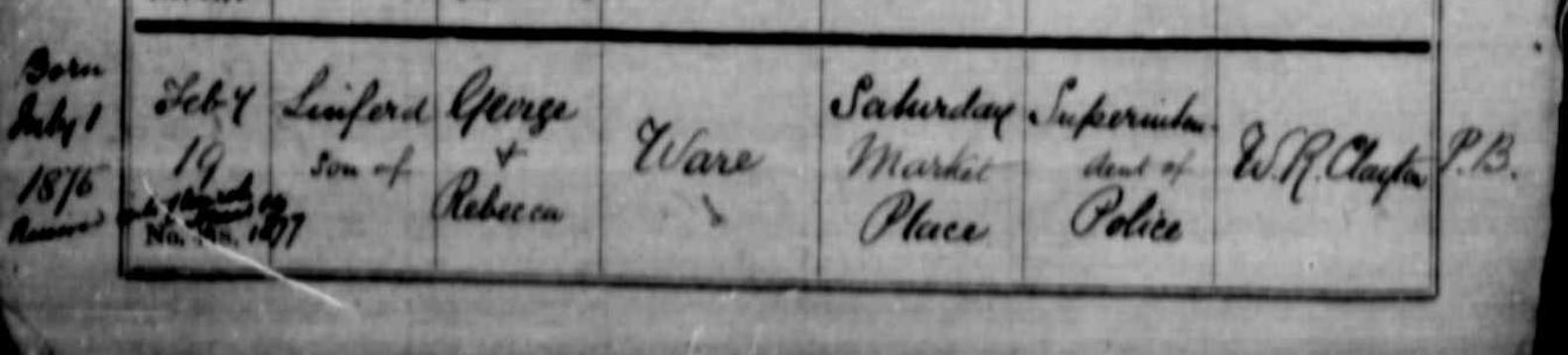
Linferd’s story reads like the life of an over-active
butterfly. By the age of 15 he was living in Regents Park Barracks in London as
a Bandsman in the First Lifeguards Brigade. The life obviously didn’t suit him
so with his father’s help he purchased a discharge for £18 and soon after
returning home he joined the Lynn police.
There were suggestions of nepotism when he was soon given more responsibility,
so he moved to the police force in Nottingham where he worked as a young
detective constable. However by 1895 he was attracted to the military again,
this time joining the Royal Dragoons, once again as a musician. He was now aged
21, 5 foot 10 inches tall, weighing 137 lbs. He had hazel eyes and dark hair.
This time he remained in the army for 3 years before once more purchasing his
discharge. Later that year Linferd Ware
married Katherine Clarke (Kitty), daughter of the Kings Lynn Dock Master. At
that time Linferd is listed as a Coal Merchant.

Linferd appears twice in the 1901 census. Once with his wife living in the centre of Southampton, occupation musician and Ship steward and in the other entry he is named as a steward aboard the steam yacht, Erin, lying off Hythe in Southampton water. The Erin has an interesting history. At the time it belonged to Sir Thomas Lipton, who also owned the Shamrock II one of the entries to the Americas cup. Linferd must have been aboard the Erin on April 30th 1901 when it towed Shamrock II to New York.


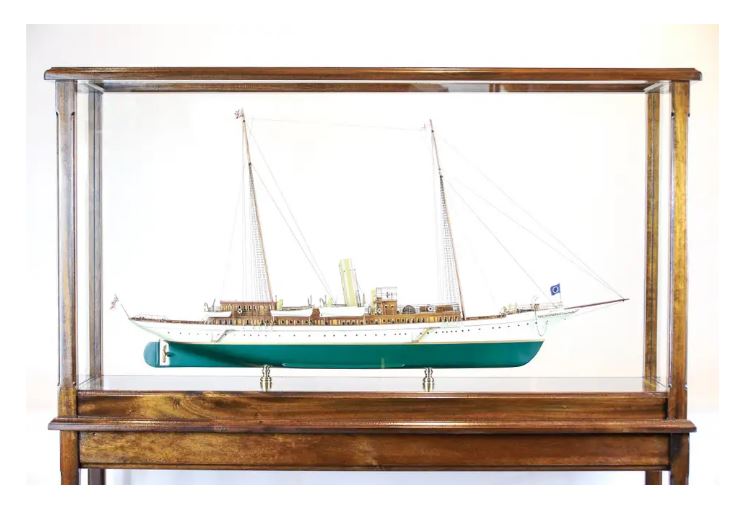 |
| A Model of the Steam Yacht Erin |

Subscribe to:
Posts (Atom)
-
 The Gaiety Theatre introduced a new style of musical comedy to London in the 1890s. The group of female dancers employed by the thea...
 -
 I have been trying to discover more about life for a 19 th century soldier’s wife and children to fill out the account of my great-grandfa...
 -
 “The most photographed woman in the British Empire” Looking through my collection of Postcards of Edwardian actresses the most stri...