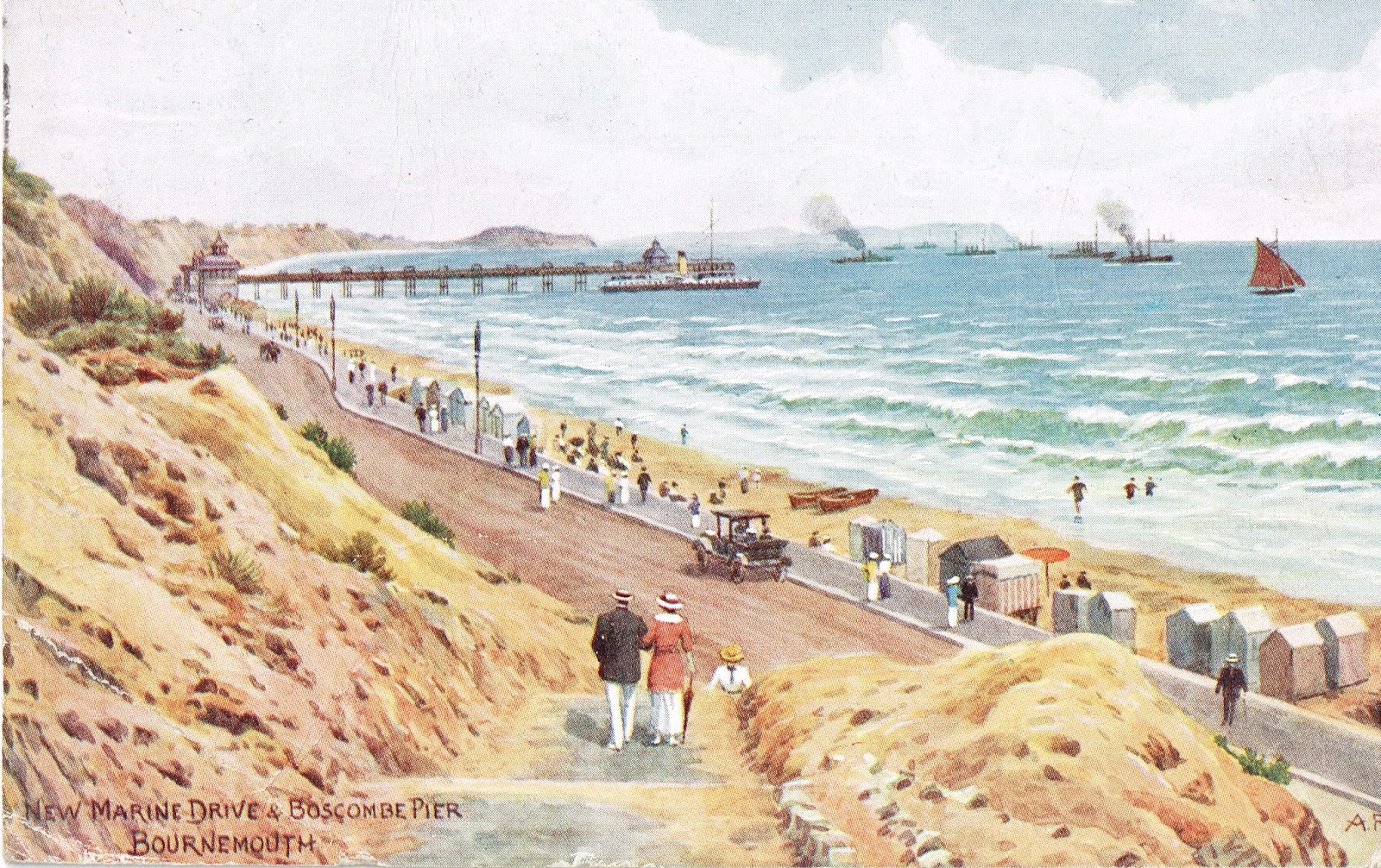
Showing posts with label seaside. Show all posts
Creation of a new town by the seaside at the beginning of the 20th century
Did your
family move to another part of the country during the late 19th or
early 20th century? As the
middle class increased in numbers and wealth, there were many professionals or
tradesmen who could afford to give up their business in the cities and retire
to a quieter place. Frequently they chose an expanding town by the seaside.
![]() |
| West Pier, Brighton 1905 |
Originally
made popular in the mid-18th century when sea-bathing and drinking
of its water were recommended as a cure-all, in Victorian times it was believed
that the bracing sea air was ideal for those suffering from respiratory
diseases such as tuberculosis as a result of living in smoke-filled cities. In consequence, in Bournemouth an “Invalids’
Walk” was laid out, connecting the town centre to the pier, which still remains
today.
My
grandparents, who were both the youngest of their family, accompanied their
parents to Bournemouth during their teens, on the retirement of their
fathers. Bournemouth had been a sparsely
populated area until the 1840s when Augustus Granville included the new town in
the next volume of his popular book on the Spas of England. Once the railway was connected to the town in
1870, high quality villas and elegant hotels were built and the population rose
from 1,707 in 1861 to 37,000 in 1891 and 60,000 by 1900.
My
grandmother continued to exchange postcards with her friends in Rotherhithe,
showing the beautiful surroundings of Bournemouth but also missing her theatre
visits in London. However she enjoyed
the musical house parties and church functions, where she met my grandfather
who, while training as an architect at Bournemouth Municipal School of Art, was
living with his father, retired Chief Constable of Kings Lynn. Two years after they settled in Bournemouth
my grandfather’s mother and sister died but a few years later his father
married a widow whom he had met in the drawing rooms of Bournemouth.
There were
in fact many opportunities for entertainment in the expanding town. In 1885 a bandstand was opened on the pier,
designed by Eugenius Birch, which had been completed five years earlier. In the summer, military bands would perform
concerts three times a day in the bandstand and as there were covered shelters
they also performed twice a day in winter.
The Bournemouth Symphony orchestra was established in 1893 and was
conducted on occasions by Elgar, Sibelius and Holst.
In Boscombe,
which attracted the wealthiest residents and holidaymakers, during the early
1890s, terraces of shops, the Salisbury Hotel, the Royal Arcade, and the Grand
Theatre were built. The famous actor, Henry
Irving brought his company to the Grand Theatre for three nights, performing
four different plays which filled the auditorium. The Grand Theatre was renamed the Boscombe
Hippodrome after refitting with furnishings from His Majesty’s Theatre in
London. At this point its range of shows
widened to include Music Hall entertainment.
An alternative venue was the Winter Gardens’ Theatre built in 1876. Between the theatres it was possible to see
Gilbert and Sullivan light operas, West End musical comedies and Drury Lane
society dramas.
In 1865,
John Sydenham, one of the proprietors of The Poole Herald, who had established
the Royal Marine Library moved it to Pier Approach, Bournemouth. There were
reading rooms containing newspapers and magazines and it was possible to borrow
books for a small
subscription. Refreshments, stationary and sheet music were also available.
On a more
practical note, in February 1877 the Royal Boscombe Hospital opened in Shelley
Road, initially with beds for 12 patients.
It was later renamed the Royal Victoria Hospital. There was a Sanatorium for those with chest
diseases and the first cemetery was established in Wimborne Road in 1877. St Peter’s church was the first to be
consecrated in 1845, but there were also religious services held in the
Assembly Rooms. Public meetings,
political gatherings and parties were also held in the Assembly Rooms and in the
adjoining Belle Vue Hotel, billiard tables could be found.
On the warm
sunny days, Bournemouth provided plenty of open space and beautiful
surroundings. Fields had been leased to
the Bournemouth Commissioners in the 1870s which were set out as Pleasure
Gardens. Wide promenades gave excellent
views of the sandy beach and the avenues were lined with trees. Before her death in June 1899, Lady Shelley,
widow of Percy Shelley the son of the poet, had gifted four acres of land which
were laid out to form Boscombe Cliff Gardens and by the turn of the century
Boscombe Chine gardens had been planted.
At Dean Park a new cricket ground was established.
The pier was
extended twice so that by 1909 it was 1000 ft. (over 300 m) long. There was a landing stage for pleasure boats
at the head of the pier while smaller craft landed on one side. The "Bournemouth Queen," a paddle steamer, commenced excursions to Swanage in 1909. On the other side of the pier there were many
bathing machines, made popular by their use at Osborne house, Isle of Wight for
the Royal family. Kept at the water’s
edge, they gave essential privacy to the bathers. Bournemouth wished to be considered a
respectable resort with no high jinks or unsuitable behaviour.
By 1910 the
boundaries of Bournemouth had expanded to include six miles of sea
frontage. Originally recommended by
Augustus Granville as, “a winter residence for the delicate constitutions
requiring a warm and sheltered locality in winter,” it had become a large
established resort for holidays, retirement and even a lifetime home for many
people.
The #Edwardian Seaside #postcards
My love for the seaside began with Sunday school outings in
the 1950s to places like Brighton, Eastbourne, Margate and Bognor, but the
height of popularity for seaside towns was in Edwardian times at the beginning
of the 20th century.
![]() |
| A family poses next to the beach |
Many seaside resorts became popular destinations during the Victorian era when the expansion of the railways made travel accessible and affordable. Most, but not all of the visitors, were middle class and their visits coincided with the popularity of the picture postcard.
While sitting on a deckchair listening to the Municipal Band
many young ladies and young men penned a postcard to friends and relations. They would show donkeys, boat trips, walking en
masse along the promenade or venturing along the pier to visit a place of entertainment.
There was no need to worry about getting sunburnt
and there were often beach tents or chalets for shelter
And if it rained there was always somewhere to go.
but sometimes you just needed a balmy evening.
Subscribe to:
Posts (Atom)
-
The Gaiety Theatre introduced a new style of musical comedy to London in the 1890s. The group of female dancers employed by the thea...
-
I have been trying to discover more about life for a 19 th century soldier’s wife and children to fill out the account of my great-grandfa...
-
“The most photographed woman in the British Empire” Looking through my collection of Postcards of Edwardian actresses the most stri...