Showing posts with label paupers. Show all posts

Snapshot of a Workhouse in 1901


Inmates listed in Guildford Workhouse on the census of 1901

Once every 10 years, the census records give us a window into the ages and occupations of Workhouse residents.  In 1891 at Guildford Workhouse the Master, Duncan MacDonald, lead a team of 10 officers, including only two nurses.  On the night of April 5th 1891 there were 276 full time resident paupers and 10 casual poor sleeping at the Union Workhouse.

By 1901 there were 396 inmates but we are not informed as to how many were casual paupers.  By 1911, this number had risen to 418, but whereas in 1901 there were 22 members of staff, in 1911 there were 29 officers and the Master, Charles Henry Bessant, had been given his own personal servant.

It is only by 1911 that a Superintendent for the Casual wards is listed and the Superintendent nurse of the 1901 Infirmary has been replaced by a married couple, who are Sick Attendants.  Miss Edith Hughes, the Superintendent Nurse of 1901, who had trained in Liverpool and held a certificate of the London Obstetrics Society, was assisted by 7 Infirmary nurses and 2 ward maids.  In 1911 the two Sick Attendants were helped by 10 hospital nurses, 2 probationer nurses and 2 infirmary wardmaids.

But I am going to concentrate on the 1901 census, which was recorded on March 31st. We find that the inmates range in age from newborn baby, Kate Hall, to 94 year old, Sarah Balchin, from Bramley.  There were 179 men sleeping in the Union Workhouse that night and 120 women.  107 children under 15 were resident, including 19 babies under 3.  Twelve of the inmates were described as imbeciles, one as an imbecile who was blind, one lunatic and one deaf and blind.  As 133 of the men and women were over the age of 68, the Workhouse was providing an old people’s home, as well as accommodation for the homeless and a children’s home.  Yet the one thing they all had in common was the definition, “pauper.”


But we learn much more about these, “paupers,” by looking into their lives.  Many families are listed far apart on the census because they are male or female regardless of the fact that they were married couples.  In the case of the Standing family, Priscilla, aged 39 is separated from her 3 sons, Harry, aged 5, Thomas, aged 4 and Edwin, aged 2.  Although the 3 brothers had each other, they were taken from their mother at a very young age and she must have missed them terribly.

You can read the story of  Priscilla Cinderalla Cooper and her family here                                    

Another sad inmate of Guildford Union Workhouse in 1901 was Alice Clair.  Intriguingly, her birthplace in 1856 was listed as, “born at sea.”  Alice became a dressmaker but in December 1880 she gave birth to Julia Alice Clair at Marylebone Workhouse.  Tragically, little Julia died in 1882 and we presume that Alice returned to her work as a dressmaker until we discover her being admitted as a patient to St Peter’s Memorial Home in Woking on 11th November 1889.  This was a women’s’ care home for poor patients run by Anglican nuns.  Once again in 1901 Alice is in an institution, this time the Workhouse in Guildford, and eight years later, she died in Guildford.

It is probable that Alice was born, “at sea,” because her father was a soldier.  Another Guildford inmate, John Bridger, had an exotic birth in Demerara, Guyana, West Indies in 1835.  At that time the British army were active in the establishment of British Guyana and the abolition of slavery there so it is likely that John was also the son of a soldier.  We do not know when he arrived in England but in 1866 he married Mary Ann Wells in Guildford.  In 1871 he was living in Thursley with his wife and two sons and was working as a wheelwright.  By 1881 the Bridger family had moved to Godalming where John was a Cowman and Mary Ann had given birth to a third son.

Something catastrophic must have occurred during the next few years, as by 1891 John Bridger was resident in the Guildford Union Workhouse, listed as married, but his wife Mary Ann was living in Peperharrow with her youngest son and was working as a housekeeper.  Perhaps John had become incapacitated by accident or illness and Mary Ann was unable to look after him as well as supporting her family?  John Bridger was still at the Workhouse in 1901 but by then he is listed as a widower.  His son, Charles, age 29 was living in Godalming, working as a Leather Dresser and next door was younger brother, John A. Bridger, a railway porter.  Yet again John Bridger senior is listed as an inmate in the Workhouse in 1911 before dying in Guildford in 1914.

A frequently occurring surname amongst the inmates of Guildford Union Workhouse was Mayo.  This family can be found, in the census of 1871, living in Summers Lane, Godalming in a caravan.  William Mayo, his wife and two of his daughters give his occupation as pedlar.  Most of the family, including 5 year old Susan, were born on the south coast.  By 1881, Susan Mayo was living in the District Village Home for Orphan, Neglected and Destitute Girls in Barking, Essex near to the residence of her married sister, Mary.  In 1891 Susan had returned to Godalming where her daughter, Rose Mayo, was born.


Susan had two more daughters, Ellen (Nellie) born in 1898 and Ivy in 1900.  She and her daughters were all residents of the Guildford Workhouse by 1901 and Susan remained there in 1911.  Rose was 20 by 1911 and had moved to Shepherds Bush to work as a housemaid.  Her sisters, Nellie and Ivy had been moved to Providence House Scattered Home in Artillery Terrace, Guildford under the care of a Foster Mother appointed by Guildford Union Board.  Susan Mayo died in Guildford in 1926.


The Master of Guildford Union Workhouse in 1901 was William James Hill, aged 42.  His wife Mary Ann Hill was Matron and they had two sons, Percy and Stanley.  William Hill had been born in Polruan, Cornwall.  In 1878 he received his Mate’s Certificate in the merchant navy and this was followed by the Master’s certificate issued in Fowey in 1880.  However William later made a change to his career and by 1891 he was acting Master of the Union Workhouse at Liskeard in Cornwall.

Among the nurses in the infirmary were Hannah Howard, aged 36, Florence Watson, aged 21 and Marie Lambourne aged 43.  Hannah Howard had been born in Hertfordshire and as a child she lived with her father William, a greengrocer, and his family in East Barnet.  By 1881, Hannah’s mother, Mary Howard, had been widowed and the family had moved to Richmond in Surrey where Mary was a charwoman and Hannah a dressmaker.  In 1891 Hannah was working as a nurse in Sussex at the County Lunatic Asylum in Wivelsfield, before moving to Guildford.  As she grew older she gave up nursing and became the cook for a family in Hornsey, Middlesex.

Florence Watson was born in 1880 in Boroughbridge, Yorkshire, the daughter of Alfred Watson, a saddler and harness maker.  After working in the Infirmary in Guildford she moved to Lancaster where she nursed an elderly retired engineer.  Marie Lambourne was born Maria Lamburn in Emsworth on Chichester harbour, daughter of Hezekiah Lamburn, a carter, and his wife Elizabeth Crees.  In 1881, Maria was working as a cook for a Canon of the Cathedral church in Chichester.  In 1891 she was a charge nurse at New Broyle Infirmary Isolation Ward, Chichester, before moving to Guildford Infirmary.

We often believe that our ancestors rarely moved from their home village but the life histories of inmates and staff of Guildford Union Workhouse clearly show how widely travelled many of them were.  We can also see how easily individuals rose and fell in status and poverty due to circumstances frequently beyond their control.


Overseers of the Poor #ParishChest

St James the Less, Pangbourne, Berkshire

Recently I’ve been reading the Berkshire Parish Overseers’ Records. They give a comprehensive view of how the poor and needy were provided for at the end of the 18th century and beginning of the 19th.  The Overseers were respectable men from the middle class selected annually to administer funds available for the poor in their parish.

When there was doubt if an individual came from your parish, Removal or Settlement Orders were made, so that each pauper was helped in their own parish, not a place they had moved to.  In 1816 when her husband was away in the army, Mary Warner was removed from the town of Reading to her home village of Pangbourne, since she would receive no money to support their family from his army pay until he returned home.


Earlier in 1798, one soldier whose wife had been allowed to accompany him, wrote home from the island of Jersey begging for assistance.


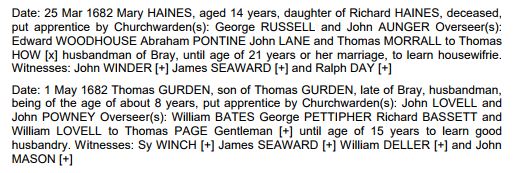
The Overseers needed to provide employment for orphans and needy children in their parish and the best solution was a 7 year apprenticeship.  Boys might be sent to a Master to learn skills such as carpentry, shoe-making or barge-building, but it might be husbandry (caring for animals and tilling the soil).  In most cases, girls were apprenticed to learn housewifery.


An apprenticeship established Settlement in a parish, which might explain why the Berkshire Overseers were eager to send their paupers to parishes on the outskirts of London, from where they were unlikely to return.

The other problem they had to deal with was bastardy.  Unmarried pregnant women should preferably be provided for by the man who was responsible.


The last bulk shop in London


The Old Fish Shop at Temple Bar, 1846
Mention “bulk shop” to anyone today and they think of ordering large quantities of goods online, but the original London bulk shops were built to replace the dangerous jettied shops after the Great Fire in 1667.  Since goods could not be displayed behind leaded panes, shopkeepers were to use hinged shelves or counters attached to the shop-front, rather than using stands which took up too much of the path.  Above the shelf they were later ordered to maintain a roof, at least half way across the footpath, to protect pedestrians from rain.  Soon they were directed to allow paupers to sleep under these roofs and the narrow eleven inch shelves were replaced with twenty inch ones so that the beggars did not roll off during the night.

The last bulk shop a poulterer's in Gilbert's Passage, Clare Market
There were many of these bulk shops in the area of Temple Bar to the north of the Strand and several were bookshops.  The Old Fish Shop at the top was taken over by Reeves and Turner, booksellers, but the building came down when Temple Bar was removed. The last bulk shop, a poulterer's in Clare Market, was destroyed in 1878.

Clare Market (top) on the edge of 6 acres of sordid courts and alleys replaced in 1882 by the Law Courts 


A new Life in Canada

One Saturday in May 1885 nine children were taken from various parts of Guildford Union Workhouse into the handsome oak-lined boardroom.  There they stood nervously before the twenty seven grand gentlemen and one lady of the Board of Guardians.  The Board included Miss Augusta Spottiswoode, one of the first women to be voted on to a Board of Guardians.  Miss Spottiswoode was anxious to break the spiral of poor or orphaned children following their parents’ path into pauperism and crime by giving them an industrial education and removing them from the workhouse by boarding out.  Now she espoused the cause of sending orphans to start a new life in Canada.

Guildford Union Workhouse
One of the children standing in front of her was Walter Shires, an 11 year old boy from a tragic family.  He can be found age 7, amongst the inmates listed in Guildford Union Workhouse in 1881 and next to him, the name Mary Ann Joyce, age 12, who was his step-sister.  Both children had been orphaned two or three years earlier, but only Walter would be part of the small party of children sent out to Canada to begin a new life.

Walter’s mother Kate May married William Joyce at St Nicholas, Guildford in 1866.  He was an Agricultural Labourer and by 1871 they were living in the area of St Catherine’s with their three children, William John Joyce, age 4, Mary Ann Joyce, age 2 and newly born Kate Elizabeth.  Sadly, Kate died within a few months and a year later their father, William Joyce, was buried in St Mary’s churchyard, aged 26.

The young widow, Kate Joyce, married again next year, this time to labourer Walter Henry Shires.  Their son, also called Walter Henry Shires was born shortly afterwards but there is no evidence of any other children born to the couple before Kate’s death in 1878.  At the age of 30, her funeral was held at St Nicholas’s.  With three young children to look after, Walter Shires senior entered Guildford Union Workhouse where he died a year after his wife, aged 37.

By 1881, the eldest boy William John Joyce was 14, so he was working as a farm servant in Hambledon.  The next time we find Mary Ann Joyce is in 1891 when she is living in Spitalfields with three other girls, all with no occupation, in the household of a Docker and a Laundress.

Meanwhile, young Walter Henry Shires was part of an experiment which hoped to give young people an opportunity of a better life in Canada than was possible, given their unfortunate start, in England.  By 1884 many stories were told by well-meaning ladies such as Miss Maria Rye, Miss Ellen Belborough and Mrs Burt about the success of taking destitute children via Liverpool to Canada where they were needed for employment as servants.

John T Middlemore and some of the young immigrants
Miss Spottiswoode was particularly eager to give some of the children from the Union Workhouse this opportunity.  She believed, ”that if all unions adopted the means at their disposal for promoting the emigration of children, it would do much to stamp out pauperism in the country.”  She had been told by John T Middlemore of his receiving home in Ontario where he had begun to send children from his Children’s Emigration Homes in Birmingham.  He undertook to arrange transport of children from poor Law Unions in Guildford, Bermondsey and Wolverhampton via Liverpool.

Despite opposition from other members of the Board, based on the young age of the emigrants, the advantage of separating the children from mixing with the children of casual paupers, outweighed the arguments.  The nine orphans, aged 3 to 9 years were summoned into the Boardroom where they were asked whether they were willing to go to Canada.  The six eldest children, including Walter Shires, Alfred Curtis and John and Annie Walker, agreed, but it was decided by the Board that the youngest three should remain in Guildford.

Guthrie Home
Just over a week later the children set sail on “The Lake Winnipeg” en route for the Guthrie Home in London, Ontario.  From there, 12 year old Walter was sent to live with J D Crane, a farmer in Chatsworth, Ontario.  Each child was subject to one inspection to check that his new home was suitable.  Walter Shires was reported to be both honest and untruthful, stubborn, sulky and a source of trouble.  He was, however, “showing signs of slight improvement,” in his behaviour, although suffering from scalp disease.


In later years Walter married and had 2 children, before his death in 1937.  He was one of over 5000 children taken to Canada by the Middlemore Homes but there were many more children who were expatriated by Barnardos, the Children’s Friend society and other organisations adding up to approximately 100 000 emigrants.

It seems fitting to conclude with a quotation from the journalist of Guildford Jottings in the Surrey Mirror in 1885,

Although one feels almost guilty of expatriating the poor little ones by deciding to send them from our shores, it does not follow that it is not in reality, the very kindest thing it is possible to do for them.  They are at a premium in Canada, they are a discount here.  It’s just as well to get a premium on one’s wares where possible.”

Sources
Surrey Mirror May 1885 via www.findmypast.co.uk
http://www.thisisourtownguildford.co.uk/guildford-workhouse-the-spike-st-lukes-hospital/
www.Ancestry.co.uk

You can read more about children sent from Guildford to Canada here