Showing posts with label postcards. Show all posts

Ada Reeve 1874-1966 “One of the Gayest of the Gaiety Girls"


Ada Reeve who first went on stage in 1878 at the age of 4 was still acting in her early 80s. Here she is on a tinted postcard at the height of her career.


The eldest daughter of an actor and a dancer, she appeared in many pantomimes as a child and she went on to perform in Edwardian musical comedies and Variety shows.  She toured Britain but also appeared in Australia and was very popular in America.


At the age of 21 she married Gilbert Joseph Hazlewood, an actor of the same age. In 1894 she starred in the title role of The Shop Girl at the Gaiety Theatre, opposite Seymour Hicks, but her advancing pregnancy meant the she was replaced by Ellaline Terriss. The couple had two daughters but within a few years it was an unhappy marriage. In 1900, Ada petitioned for a divorce citing her husband for cruelty and adultery with Mildred Cobb, Dolly Daintree “and various other women." She was given custody of her daughters.


Later that year while appearing as Cleopatra at The Comedy Theatre in London she slipped out during the first act, catching a “hansome to the Palace Theatre of Varieties” where she put on a turn before completing the next act back at the Comedy Theatre!

In 1902 Ada remarried, this time to Wilfred Cotton, an actor and manager, and he moved into her apartment in Buckingham Gate.  Soon Ada and Wilfred bought a property on the Isle of Wight and Ada subsequently toured South Africa in 1906, returning in 1909 due to her popularity. 


In 1908 she appeared in the musical comedy Butterflies at the Apollo theatre in London.

In 1917 Ada appealed to the courts in Australia to remove her husband Wilfred as her Manager. This was only one of many court cases involving disputes between Ada and other agents in England and Australia.

Ada continued touring South Africa and Australia until 1929. She then remained in Australia, where both her daughters had settled, until 1935.

Back in England she acted on stage and in films throughout the 1940s and 50s. In 1957 she appeared on TV in a production of Nicholas Nickleby.

Ada Reeves died in 1967 at the age of 92 and in the following year Judi Dench unveiled a memorial plaque at St Paul's Covent Garden, The Actors Church.

Details of birth, marriages and divorce from Ancestry.com

Newspaper reports from FindMyPast.co.uk

Postcards from my Grandmother's collection

Lewis Waller and Florence West, a couple of Victorian actors


I discovered the show business couple of Florence West and Lewis Waller thanks to a postcard posted on Twitter by MissHistoryGal.  Starting their careers a little earlier than the Edwardian actors I usually research I hadn’t been aware of their interesting lives.
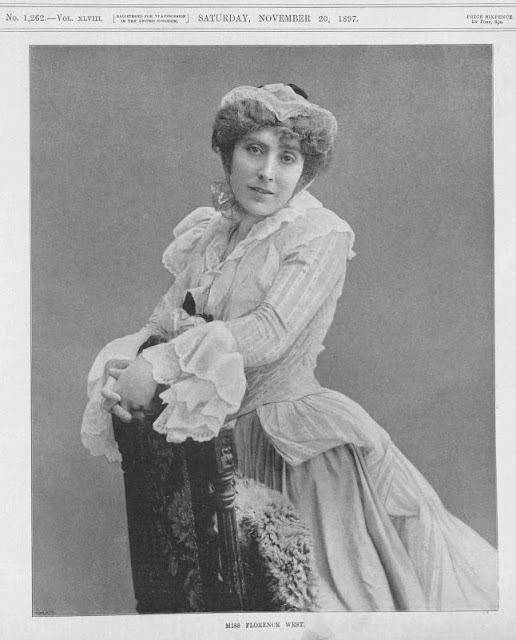

Florence Isabella Brandon was born in Chiswick in December 1859, the eldest daughter of Horatio Brandon a successful solicitor. She had 6 sisters and 2 brothers. She was a keen amateur actress who decided to write to the famous comedian J L Toole to ask for employment with his theatrical company. Having convinced him that she was a serious actress he gave her a trial. Using the stage name of Florence West, she can be found on the billboards of Mr Toole’s company in London and touring England in 1882. In that same year she had quietly married William Waller Lewis, also a keen amateur actor. When a fellow cast member fell ill, she suggested her husband take the part. For several years, Florence continued using the stage name Florence West, perhaps not wanting to affect the matinee idol image which Lewis had acquired along with a host of young female fans. However they were frequently partners on stage.


Lewis was born William Waller Lewis in Bilbao Spain. His father William James Lewis was English, his mother Carlotta Vyse, Spanish. For 5 years he was employed in the city of London, but he always wanted to use, “his fine rich voice,” on stage. His romantic good looks soon made him popular in swashbuckling roles. Florence’s sister, (Constance) Margaret, who as Mrs Clement Scott became theatre critic of the John Bull magazine, described Lewis thus,

“He lived in Cloudland as an enthusiast, a romanticist, a bit of a Don Quixote, a splendid, honest, straightforward, virile man.”

Harry Esmond described Waller’s school of plays as, “The Sword and Caper drama.”


In the mid-1890s he was actor/manager of the Royal Haymarket Theatre and he later impressed with his Shakespearian characters.


The couple had two children, Edmund Lewis Waller born in 1884 who followed his father on stage and Nancy Waller born in 1896. 


In the 1890s as Mrs Lewis Waller, Florence started her own touring company of actors.  In 1904, Florence objected strongly to, “the advertisement of soaps and corsets,” between acts on the screened stage. “I object to half-dressed people being thrown on the screen.”  Such was her influence that the practice stopped during her performances. One of the actresses Florence employed was Ethel Warwick, a famous artists’ model. Ethel later married Edmund Waller Lewis but sadly the marriage ended in divorce.


Both Florence and Lewis died young, Florence, aged 53, in 1912, while her husband was in New York and Lewis of pneumonia, aged 55, in 1915 after a long tour of America, Canada and Australia, with his daughter Nancy by his side.


The African explorer, the séance and the post-card Beauty – Isabel Jay’s unfortunate marriage #EdwardianActress #MondayBlogs


When I was a young child of about 7 or 8, my parents took me to performances of the light operas by Gilbert and Sullivan which I absolutely loved, so when I discovered that one of the popular beauties of Edwardian post cards, Isabel Jay, had become part of the D’Oyly Carte company after singing for Arthur Sullivan, I wanted to know more about her life.

In 1901 a journalist interviewed Isabel and her mother at their residence in Westminster Palace Gardens. She appeared to be sweet and naïve, proud of her achievements while at the royal Academy of Music when she had been awarded bronze and silver medals for elocution and a gold medal for operatic singing.  She was still practising the piano each day but really enjoying the parts she had been given in The Mikado, Iolanthe and the Pirates of Penzance.


A reviewer for The Era wrote of her: "Miss Isabel Jay's bright, alert acting and fascinating personality would have condoned many deficiencies. But in addition to winning all hearts by her freshness and earnestness, Miss Jay gave us a delightfully easy and accomplished rendering of her share of the score, and the way in which she used a very valuable voice told of sound training and keen intelligence."

Isabel Jay left the company in 1902 to marry the explorer Henry Sheppard Hart Cavendish


Henry Sheppard Hart Cavendish, born in Kensington in 1876, was famous for his explorations and hunting achievements. After leaving Eton, he travelled widely in Africa, firstly shooting big game up the Zambesi. Later he visited the west side of Lake Rudolph in East Central Africa making notes for the Geographical Society of London. On this journey he was accompanied by 80 armed Somalians and 150 camels. When he reached Lake Stephanie a wounded elephant charged him and sat on him for 30 minutes. Its head was presented to the British museum. Cavendish also returned to London with 38 kinds of game. When in England he loved music, classical and popular and this is how he came to meet Isabel Jay.


Cavendish also attracted the attention of journalists. Photographs of his London home in 1900 showed the collection of antelope, elephant, giraffe, buffalo and lion heads which he had shot personally.  Prior to his marriage Cavendish became entangled in a friendship with a man called Major Strutt after believing his dead mother told him at seances to make the Major his financial advisor. Early in the marriage Cavendish was bankrupt and their relationship was in trouble.  The details of their subsequent divorce are painful to read because of his ill-treatment of Isabel but amazingly he remarried four more times.


Isabel returned to the stage in 1903 and after Cavendish reneged on this promise to give up alcohol the couple were divorced in 1906.

Isabel Jay
Frank Curzon

 In the meantime, Isabel appeared in productions of the actor manager Frank Curzon and the couple eventually married in 1910.  Isabel retired from the stage at the age of 31 before the birth of her second daughter. She died in 1927, aged 47, in Monte Carlo. Her husband Frank died later that year, after watching the horse he had trained win the Derby.

The RSM Isabel Jay Medal for Singing
You can read more about Cavendish and Major Strutt at Stage Beauty

Edna May - Edwardian actress #biography #oldpostcards


Edna May Petty was born in the city of Syracuse in New York State. Her parents encouraged her ability to sing and entertain and like her sisters, Jennie and Marguerite, she became a child star.  By the age of 7, she was performing in productions of HMS Pinafore and The Pirates of Penzance.  At 16, she travelled to New York to study music at the Conservatoire but while there she met and fell in love with Fred Titus, a celebrated professional cyclist and in 1895, at the age of 17, she married him.  Her first performance in New York was in 1896, when Oscar Hammerstein cast her in Santa Maria, but her big break was in September 1897 when she appeared as a sweet Salvationist in The Belle of New York. Although a moderate success the play’s real fame occurred when the production moved to London. Edna May was soon a favourite among postcard collectors.


Now a star, she made frequent performances in London and in New York. Her marriage failed, and she and Fred Titus divorced in 1904. In 1906 The Belle of Mayfair opened at the Vaudeville Theatre. Edna played a similar character to that of The Belle of New York and the Manchester Courier reported,
"The Belle of Mayfair" is synonymous with Miss Edna May, who received a warm welcome last night, but the play is by no means a one part piece, and there are half a dozen actresses who could impersonate the title role charmingly.”
This may have influenced the actress as she later walked out of the cast. Miss May objected to the featuring of Camille Clifford jointly as a joint star on The Belle of Mayfair bills. The theatre management's retort was that they must feature Miss Clifford, because she was engaged to marry a British nobleman.  Edna May was particularly upset that a special song had been written for Miss Clifford, Why am I a Gibson Girl, but that no suitable song had been found for her. More scandal was to follow when the 15 year old, Phyllis Dare was brought back from school in Belgium to take over from Miss May rather than the understudy.


In fact, Edna May soon found her own fiancé, not a British nobleman but an American millionaire. Oscar Lewisohn 6 years her junior, was the son of Adolph Lewisohn, the copper King.  The couple lived in Berkshire but to the dismay of her public Edna was retiring from the stage. Her swan song was the play Nelly, Nelly 


Edna briefly returned in 1911 to perform The Belle of New York York at the Savoy Theatre and in 1915 The Masque of Peace and War in London. Edna’s husband died in 1917. At first she remained in Berkshire but by 1936 she had moved into the Ritz in London. She died in Lausanne in Switzerland in 1948.

To read more about The Gibson Girls


Cléo de Mèrode, spirit of La Belle Epoque


In Paris, La Belle Epoque, the Beautiful Era began in 1871, when the Franco-Prussian War ended, and lasted until the First World War began in 1914.  The French Third republic enjoyed a time of peace and prosperity and the joi de vivre inspired a golden age of music and literature.  In 1889 the World Trade Fair was held in Paris and the new Eiffel Tower shown to all the visitors.  Many flocked to see Burlesque at the Folies Bergère and Art Nouveau was indeed a new and popular design style.

L'Opera, Paris


In this environment, the dancer Cléo de Mèrode flourished. Descending from Austrian aristocracy, she was enrolled for dancing lessons when she was 7, at the Paris Opera Ballet, making her debut at the age of 11. Her beauty and graceful dancing prompted Degas to include her in his ballet paintings, Alexandre Falguière to sculpt The Dancer, using Cléo as his model and Toulouse Lautrec to paint her portrait.  Many photographs were taken, showing her slim waist and distinctive hairstyle and postcards of her image were avidly collected.


In her private life she enjoyed cycling and playing the piano.  In 1896 King Leopold II of Belgium visited Paris, saying he had come to see Cléo dance.  He sent her dozens of presents and as the 61 year old King had previously had many affairs it was presumed that he was now involved with the 22 year old dancer.  Cléo was horrified at the effect on her reputation and denied any involvement but later choosing to dance at the Follies Bergère did nothing to enhance the public’s opinion of her morals.  Despite this she became an international star.  She earned a great deal of money, briefly acting and dancing in America and when she toured Scandinavia in 1904, she received 3000 love letters from fans.


Cléo de Mèrode continued dancing into her 50s when she retired to the chic seaside resort of Biarritz.  There she gave ballet lessons until she was over 80.  She never married and confessed to only two relationships. When she died in 1966 she was buried in Père Lachaise cemetery in Paris.


The tomb of Cléo de Mèrode