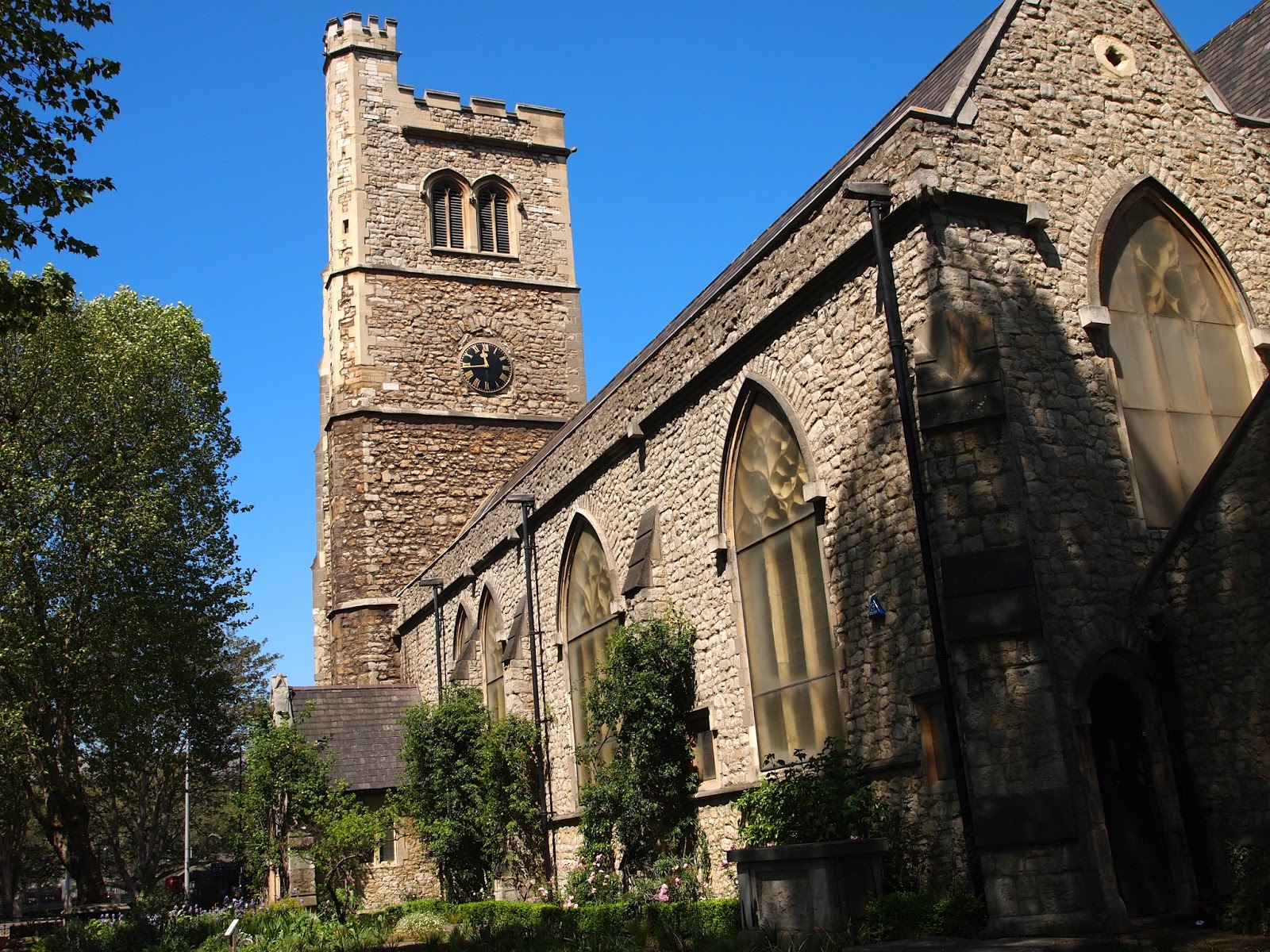
Standing outside the Garden Museum in St Mary’s church, by
the side of Lambeth Palace it can seem like a peaceful spot which time has
forgotten but Lambeth has seen many dramatic changes reflecting the use of the
river Thames.
Until the 18th century there were very few people
living on the marshy land of Lambeth but the gently sloping beach was an ideal spot to keep boats and barges and soon the fishermen were joined by potteries, factories and saw mills.
Most people adapted to the new industrial opportunities but
the fishermen were severely affected by a rapid depletion in fish stocks. Living in small cramped houses with sewage
discharged directly onto the beach they were tempted to find less honest means
of making a living. Pretending to fish
they would dredge for coals fallen from lighters or plunder the barges. Their apprentices were often mistreated and
trained to be thieves both on the river and on land.
In 1832 the newspapers ran detailed accounts of a probable murder involving fishing
apprentices. Two
gentlemen, Mr Smales, a respectable printer and stationer, and his friend, Mr Wilkinson set out from Blackfriars in a small “funny”
boat at 9 pm on July 17th rowing towards Vauxhall Bridge. At about 10 minutes to ten, when they were
through the bridge towards the Spread Eagle at Millbank, 15 feet from the
Middlesex side of the river, a skiff came alongside containing two young
men. One youth held the boats alongside
each other while the other stole the older men’s jackets, which were lying in
their boat. Mr Smales tried to hit the
thief with his oar but the other boat turned away so Wilkinson tried to jump
across. Falling into the river, he swam
to the skiff and took hold of the gunwale.
At that point, according to Smales, both young men struck Wilkinson on
the head with their sculls giving him several blows until he let go and sank
down into the river. Crying out, “Murder,”
Smales tried to row towards his drowning friend but with one small scull and
one longer oar the boat turned back on itself.
The scene was witnessed by John Rowan, a jack-in-the-water
at the Spread Eagle. His job was to
attend at the dockside stairway to help secure boats. This was his testimony at
the trial,
“I was on the causeway till ten minutes before ten o'clock,
when the last boat went away; I was then standing at the water edge, about
forty yards from the house; I took my stool to the house; and about five
minutes past ten I heard cries of Murder! - I got out of a boat's head, in
which I was laying, but did not attend to the cry, till I heard it a second
time - I heard a guggling; I knew then it was somebody drowning; I ran to the
house, and as I ascended the stairs, I heard the guggling a second time - I called
the waiter - he came instantly with me to the causeway, got into a gentleman's
boat, and before we took twenty strokes, we came alongside of a boat, with Mr.
Smales standing up in it - he put his hands together, and said, "My friend
is gone!"
The perpetrators of the crime might never have been
discovered had it not been for a tip off by Kitley, another youth, a fellow
fisherman’s apprentice. To ensure he was
not under suspicion he suggested that the constables visit a costermonger,
Robert Gare, who might have information about the stolen coats. At first Gare denied all knowledge of the
incident but after the officers found one of the coats hidden under ashes in
the dustbins at Gare’s mother’s house, he admitted that William Brown, a young
apprentice, whom he had known at school, had asked him to look after the coat. Kitley also gave information about the other
stolen jacket which was found in a barge's head at Robert Talbot's premises at Fore
Street, Lambeth, under the head sheets.
They soon identified the other youth as William Kennedy and
the two young men were brought to trial at the Old Bailey, indicted for the
wilful murder of William Wilkinson. Mr
Bodkin, conducting the prosecution used the testimony of James Kitley to
incriminate the accused.
“I was employed in the barge, Hieron, which was under repair
at Lambeth; I know both the prisoners - Kennedy had been sleeping on board that
barge for some time before the 17th; on Tuesday, the 17th, about ten o'clock, I
think, but cannot tell, as I never looked at the clock, Kennedy came to me for
the key - my barge laid about a mile and a quarter from the Spread Eagle; he
appeared to me to be in a muck sweat I told him I was going myself directly,
but he pressed me to give him the key - I did, and he went towards the barge by
himself - I went myself in less than half an hour, and slept on board that
night. I did not see Kennedy when I went
into the cabin, but he must have been there, for he got up with me in the
morning, and he and I, went to a beer-shop kept by Bean; I asked Bean's son for
a light. Kennedy pulled out some papers
and a book out of his pocket - he tore some of the papers, saying he wanted to
burn them, and I tore some of them, not knowing what they were; the pieces were
thrown into the grate of the room we were in. Flack lighted his pipe, and threw
the paper which he lighted it with into the grate, and the papers caught fire;
I cannot say whether they were partly or entirely burnt - I was going out in
about an hour, when the officers came and took Kennedy into custody; they
afterwards called me - I went to them, and went before the Magistrate with
them, and after we had been before the Magistrate, Kennedy told me, that he and
Brown were guilty. We were all in
custody under suspicion at the time, but Kennedy said we need not fear, for he
would turn us up - he told me he had put one of the coats in a barge at the
back of a barge-builder's place, but the barge-builder had moved away; I
informed a gentleman at the office of it and I described where the barge was.”
Unburnt sheets from the pocket-book were handed over to the
Thames police and Mr Smales identified his friend’s handwriting.
Further evidence was given that Brown and Kennedy had been
seen nearby shortly before a skiff was stolen from Moore’s boat builders in
Lambeth that night.

Both William Brown and William Kennedy confessed to stealing
the coats from the boat but denied the murder of William Wilkinson. Five witnesses gave Kennedy a good character. The judgement was that both men were guilty
and they were condemned to death but were later respited during His Majesty's pleasure. Meanwhile two young apprentices made a
violent attack on Thomas and Elizabeth Woodcock, William Kennedy’s Master and
his wife, in their house in Fore Street, Lambeth, maintaining they had badly
mistreated their apprentice and a mob burnt an effigy of the couple on the
street. The jury who had tried Brown and
Kennedy were not convinced that the young men had even injured Wilkinson so
they drew up a petition against their death penalty, resulting in commutation
of the punishment. There were many
letters in the newspapers both condemning the harsh sentence and maintaining it
should be carried out but finally Brown and Kennedy were reprieved.