Showing posts with label social history. Show all posts

Snapshot of a Workhouse in 1901


Inmates listed in Guildford Workhouse on the census of 1901

Once every 10 years, the census records give us a window into the ages and occupations of Workhouse residents.  In 1891 at Guildford Workhouse the Master, Duncan MacDonald, lead a team of 10 officers, including only two nurses.  On the night of April 5th 1891 there were 276 full time resident paupers and 10 casual poor sleeping at the Union Workhouse.

By 1901 there were 396 inmates but we are not informed as to how many were casual paupers.  By 1911, this number had risen to 418, but whereas in 1901 there were 22 members of staff, in 1911 there were 29 officers and the Master, Charles Henry Bessant, had been given his own personal servant.

It is only by 1911 that a Superintendent for the Casual wards is listed and the Superintendent nurse of the 1901 Infirmary has been replaced by a married couple, who are Sick Attendants.  Miss Edith Hughes, the Superintendent Nurse of 1901, who had trained in Liverpool and held a certificate of the London Obstetrics Society, was assisted by 7 Infirmary nurses and 2 ward maids.  In 1911 the two Sick Attendants were helped by 10 hospital nurses, 2 probationer nurses and 2 infirmary wardmaids.

But I am going to concentrate on the 1901 census, which was recorded on March 31st. We find that the inmates range in age from newborn baby, Kate Hall, to 94 year old, Sarah Balchin, from Bramley.  There were 179 men sleeping in the Union Workhouse that night and 120 women.  107 children under 15 were resident, including 19 babies under 3.  Twelve of the inmates were described as imbeciles, one as an imbecile who was blind, one lunatic and one deaf and blind.  As 133 of the men and women were over the age of 68, the Workhouse was providing an old people’s home, as well as accommodation for the homeless and a children’s home.  Yet the one thing they all had in common was the definition, “pauper.”


But we learn much more about these, “paupers,” by looking into their lives.  Many families are listed far apart on the census because they are male or female regardless of the fact that they were married couples.  In the case of the Standing family, Priscilla, aged 39 is separated from her 3 sons, Harry, aged 5, Thomas, aged 4 and Edwin, aged 2.  Although the 3 brothers had each other, they were taken from their mother at a very young age and she must have missed them terribly.

You can read the story of  Priscilla Cinderalla Cooper and her family here                                    

Another sad inmate of Guildford Union Workhouse in 1901 was Alice Clair.  Intriguingly, her birthplace in 1856 was listed as, “born at sea.”  Alice became a dressmaker but in December 1880 she gave birth to Julia Alice Clair at Marylebone Workhouse.  Tragically, little Julia died in 1882 and we presume that Alice returned to her work as a dressmaker until we discover her being admitted as a patient to St Peter’s Memorial Home in Woking on 11th November 1889.  This was a women’s’ care home for poor patients run by Anglican nuns.  Once again in 1901 Alice is in an institution, this time the Workhouse in Guildford, and eight years later, she died in Guildford.

It is probable that Alice was born, “at sea,” because her father was a soldier.  Another Guildford inmate, John Bridger, had an exotic birth in Demerara, Guyana, West Indies in 1835.  At that time the British army were active in the establishment of British Guyana and the abolition of slavery there so it is likely that John was also the son of a soldier.  We do not know when he arrived in England but in 1866 he married Mary Ann Wells in Guildford.  In 1871 he was living in Thursley with his wife and two sons and was working as a wheelwright.  By 1881 the Bridger family had moved to Godalming where John was a Cowman and Mary Ann had given birth to a third son.

Something catastrophic must have occurred during the next few years, as by 1891 John Bridger was resident in the Guildford Union Workhouse, listed as married, but his wife Mary Ann was living in Peperharrow with her youngest son and was working as a housekeeper.  Perhaps John had become incapacitated by accident or illness and Mary Ann was unable to look after him as well as supporting her family?  John Bridger was still at the Workhouse in 1901 but by then he is listed as a widower.  His son, Charles, age 29 was living in Godalming, working as a Leather Dresser and next door was younger brother, John A. Bridger, a railway porter.  Yet again John Bridger senior is listed as an inmate in the Workhouse in 1911 before dying in Guildford in 1914.

A frequently occurring surname amongst the inmates of Guildford Union Workhouse was Mayo.  This family can be found, in the census of 1871, living in Summers Lane, Godalming in a caravan.  William Mayo, his wife and two of his daughters give his occupation as pedlar.  Most of the family, including 5 year old Susan, were born on the south coast.  By 1881, Susan Mayo was living in the District Village Home for Orphan, Neglected and Destitute Girls in Barking, Essex near to the residence of her married sister, Mary.  In 1891 Susan had returned to Godalming where her daughter, Rose Mayo, was born.


Susan had two more daughters, Ellen (Nellie) born in 1898 and Ivy in 1900.  She and her daughters were all residents of the Guildford Workhouse by 1901 and Susan remained there in 1911.  Rose was 20 by 1911 and had moved to Shepherds Bush to work as a housemaid.  Her sisters, Nellie and Ivy had been moved to Providence House Scattered Home in Artillery Terrace, Guildford under the care of a Foster Mother appointed by Guildford Union Board.  Susan Mayo died in Guildford in 1926.


The Master of Guildford Union Workhouse in 1901 was William James Hill, aged 42.  His wife Mary Ann Hill was Matron and they had two sons, Percy and Stanley.  William Hill had been born in Polruan, Cornwall.  In 1878 he received his Mate’s Certificate in the merchant navy and this was followed by the Master’s certificate issued in Fowey in 1880.  However William later made a change to his career and by 1891 he was acting Master of the Union Workhouse at Liskeard in Cornwall.

Among the nurses in the infirmary were Hannah Howard, aged 36, Florence Watson, aged 21 and Marie Lambourne aged 43.  Hannah Howard had been born in Hertfordshire and as a child she lived with her father William, a greengrocer, and his family in East Barnet.  By 1881, Hannah’s mother, Mary Howard, had been widowed and the family had moved to Richmond in Surrey where Mary was a charwoman and Hannah a dressmaker.  In 1891 Hannah was working as a nurse in Sussex at the County Lunatic Asylum in Wivelsfield, before moving to Guildford.  As she grew older she gave up nursing and became the cook for a family in Hornsey, Middlesex.

Florence Watson was born in 1880 in Boroughbridge, Yorkshire, the daughter of Alfred Watson, a saddler and harness maker.  After working in the Infirmary in Guildford she moved to Lancaster where she nursed an elderly retired engineer.  Marie Lambourne was born Maria Lamburn in Emsworth on Chichester harbour, daughter of Hezekiah Lamburn, a carter, and his wife Elizabeth Crees.  In 1881, Maria was working as a cook for a Canon of the Cathedral church in Chichester.  In 1891 she was a charge nurse at New Broyle Infirmary Isolation Ward, Chichester, before moving to Guildford Infirmary.

We often believe that our ancestors rarely moved from their home village but the life histories of inmates and staff of Guildford Union Workhouse clearly show how widely travelled many of them were.  We can also see how easily individuals rose and fell in status and poverty due to circumstances frequently beyond their control.


Linferd Ware: My missing Great Uncle


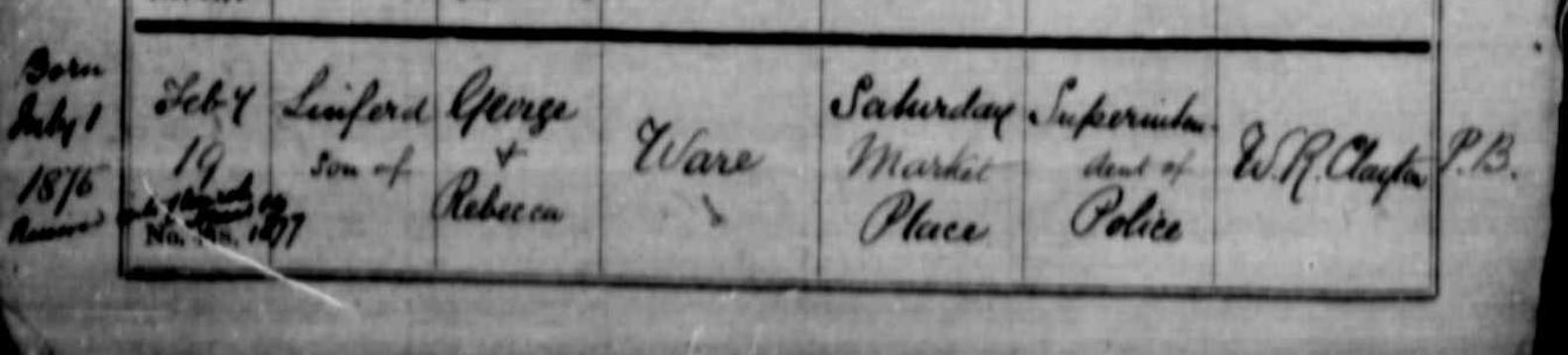
Linferd Ware was the Great Uncle who most intrigued me and until this week he was also uncompleted, a brick wall. He was the third child of my Great Grandfather George Ware and his second wife, Rebecca Linferd, born on July 1st 1875.  Like all their children he was born above the Town Hall in the Saturday Market Place Kings Lynn. This was because his father was Police Superintendent based in the Town Gaol next door.


Linferd’s story reads like the life of an over-active butterfly. By the age of 15 he was living in Regents Park Barracks in London as a Bandsman in the First Lifeguards Brigade. The life obviously didn’t suit him so with his father’s help he purchased a discharge for £18 and soon after returning home he joined the Lynn police.  There were suggestions of nepotism when he was soon given more responsibility, so he moved to the police force in Nottingham where he worked as a young detective constable. However by 1895 he was attracted to the military again, this time joining the Royal Dragoons, once again as a musician. He was now aged 21, 5 foot 10 inches tall, weighing 137 lbs. He had hazel eyes and dark hair. This time he remained in the army for 3 years before once more purchasing his discharge.  Later that year Linferd Ware married Katherine Clarke (Kitty), daughter of the Kings Lynn Dock Master. At that time Linferd is listed as a Coal Merchant.


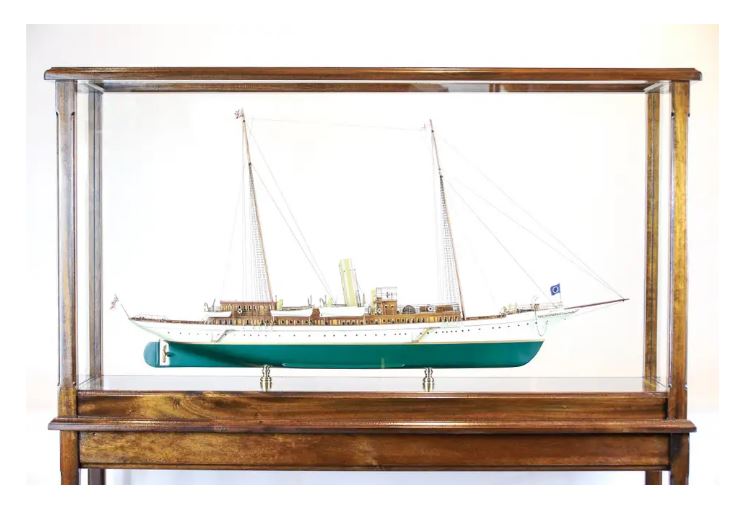
Linferd appears twice in the 1901 census. Once with his wife living in the centre of Southampton, occupation musician and Ship steward and in the other entry he is named as a steward aboard the steam yacht, Erin, lying off Hythe in Southampton water.  The Erin has an interesting history. At the time it belonged to Sir Thomas Lipton, who also owned the Shamrock II one of the entries to the Americas cup. Linferd must have been aboard the Erin on April 30th 1901 when it towed Shamrock II to New York.


A Model of the Steam Yacht Erin


After that I was unable to find any trace of Linferd though I suspected a death when he was not named in his father’s will in 1911.  Finally, I found a small death report in the Lynn Advertiser saying that Linferd Ware had died in the Memorial Hospital in Bulawayo, in the Eastern Cape in September 1909 aged 34.  I believe his wife Kitty was with him as Katharine Ware is on the passenger list of a ship sailing from Cape Town to Southampton in 1912.


Travelling through my Early Life #WWWblogs

Spending most of this year not travelling but staying at home has made me think about how I travelled during the first 20 years of my life.  At the time I was born in Scotland in 1950 the plough on my Grandparents farm was pulled by two horses. Here is my Gran with Dick and Donald.


For the rest of the 1950s I lived in a terraced house in Mitcham in Surrey, which is now considered to be south London. I don't think anyone in our road had a car but we had milk delivered by the Co-op electric milk float and bread by this horse and cart. Coal was delivered in sacks carried along an alley to the back of the house and from time to time the rag and bone man or the knife grinder would call round. The street lamps still ran by gas, switched on each evening. To go to central London, my father would catch a bus to his office, while my mother and I would sometimes take a trolleybus to Croydon or take the bus to Tooting for the underground into London.


We moved away from Surrey in 1961 and so I didn't ride on another trolley bus till 1968 when I arrived in Reading, Berkshire to discover they still had trolley buses.  Meanwhile in Glasgow on holiday I was able to ride on trams for many years.


Like most people I travelled on school buses and eventually my father learnt to drive and bought a car.  A succession of Fords ended with me buying his old Ford Corsair.


Prior to that, in 1966 we had sailed to Singapore, where we lived for 3 years, on the P & O Cathay, a 14000 ton ship for 300 passengers. There was a small pool, films were shown and entertainment such as quizzes and music were offered. Going through the Suez Canal was an interesting experience but this stopped in 1967 due to the Arab Israeli war.  


After 3 years we returned via Australia and South Africa on P & O Himalaya, a much larger ship taking 1416 passengers. It was full of young Australians going to Europe for a year and elderly British people returning after visiting their families who had emigrated to Australia.


While I lived in Singapore we took a mini cruise to Hong Kong in April 1967. We sailed there on an Italian ship the Achille Lauro which served amazing Italian food but had rather too many cockroaches in the cabins.


The Achille Lauro was to become famous for disasters. On October 7, 1985, four men representing the Palestine Liberation Front took control of the cruise liner off Egypt as she was sailing from Alexandria to Port Said The hijackers held the passengers and crew hostage and directed the vessel to sail to Syria,  demanding the release of 50 Palestinians from Israeli prisons. After being refused permission to dock at Tartus, the hijackers murdered wheelchair-bound American passenger Leon Klinghoffer and threw his body overboard. The ship headed back towards Port Said, and after two days of negotiations, the hijackers agreed to abandon the liner in exchange for safe conduct and were flown towards Tunisia aboard an Egyptian plane.

 On November 30, 1994, the Achille Lauro caught fire off the coast of Somalia while enroute to South Africa. Abandoned, the she finally sank on December 2.

I didn't sail on another ship until 2012!


The Sad Tale of the Paupers Nobody Wanted : Proving the right of a British Citizen


In recent years, recent days even, we have heard people in this country denouncing refugees crossing from France because, “the British Taxpayer has to provide for them.”  In 1834 the government passed the New Poor Law to reduce the burden on the rate payers in England of providing for paupers with out relief by replacing it with indoor relief within the Union Workhouse.  The old rules of Settlement, where birth in a parish was necessary to receive help no longer applied so clearly but gradually the right of aid within a union of parishes was established.

However, in one sad case in Surrey and Hampshire no rights of support were legally allowed. It concerned a family where the wife, Catherine Stringer, had been born in Prussia (Germany), the daughter of a British soldier, and her husband, Michael Stringer, the son of a freed slave who had been born in Jamaica was considered a foreigner even though he received a soldier’s pension after more than 20 years’ service in the British army.

In November 1854, Catherine Stringer, who with her husband, Michael, had given birth to 14 children, presented herself at Guildford Union Workhouse, with her youngest 3 children because her husband had seduced their adopted orphan child, who at 18 was expecting his baby. Catherine was a British subject in every census record but had no right to poor relief.  Her husband was stationed in the barracks in Guildford, but when the Guildford Board of Guardians discovered she had a son-in-law in Portsmouth (where Catherine had once lived) who could take her in, they bought her train tickets so she could remove herself and her youngest children to Portsea.  Mr Ames, Master of the Workhouse took them to Guildford station and accompanied them in the carriage to Woking station where he put them on the Portsmouth train.

Subsequently the Poor Law Board in London ruled this removal from Guildford to Portsmouth was illegal.

Michael Springer is described on his pension documents as 5 ft 8 inches tall with dark brown hair, grey eyes and a swarthy complexion. He had a good military record and was a Sergeant as well as a Bugle Major. He retired aged 38 because of arthritis, probably caused by many years of service in Ireland after his upbringing in the warmer climate of Jamaica where he was born. In 1821 Michael married Catherine after meeting her in Halifax, Nova Scotia, where her father was also serving as a soldier.

Michael had served as a Bugle Major for 19 years with the 2nd Battalion 60th Infantry Regiment but prior to that he had enlisted in Jamaica at the age of 12. After being discharged in Ireland in 1834, where many of his children were born, he moved to the more favourable climate of Portsmouth. Unfortunately in 1851 he was convicted of the felony of larceny, which is why the 1851 census lists Catherine as Head of the house.

On finishing his sentence in 1852, Michael joined the Surrey Militia in Guildford until his discharge in 1854 when like his estranged wife he moved back to Portsmouth where some of their adult children lived. Soon his itchy feet took him back to Cork in Ireland but in 1861 Catherine is still in Portsmouth with some of her children.


I believe Michael remarried in Cork, probably bigamously but in 1875 Catherine died in poverty in the Union Workhouse on Portsea Island.


The problems the couple had in establishing rights as British citizens despite valid parentage, being born abroad as a result of her father's army service and in Michael's case owing him reward for his duty to Britain as a soldier, reflect the experiences of the Windrush generation and also of the difficulty experienced by some of my generation in obtaining a British passport because they were born in Singapore or Malaysia due to their father's military service. No wonder they had such tempestuous lives.


Prisoner in Wandsworth in 1873


I have been taking advantage of the free Lockdown Downloads from Discovery/national archives to browse two albums of Prisoner details from Wandsworth 1872-73. Among them was this rather engaging photo of Sidney Attfield so I decided to research his life. I was excited to find him living in Guildford Union Workhouse in both 1851 and 1881 since I have been a volunteer researcher there for several years.


Born in 1840 in the rural village of Albury in the Surrey Hills, he had 5 sisters and 5 brothers as well as 6 older half siblings. In 1848 his mother had died so by 1851 he and his older sister Sophia were in the Workhouse while the other children, younger and older, were still with their father.


Looking at Sidney’s prison record I discovered he was also in the Workhouse in 1858 when he absconded with workhouse clothing, and prior to that he had stolen a saucepan and a pair of shoes in 1856 and 1857.  There is a gap in his record of crimes until 1873 when he was listed as homeless and had stolen onions.


 His longest sentence was for the following crime in his home village.


So where was he in those missing years, since I could not find him in the 1861 or 1871 census? The answer lay in the Royal Chelsea Pensioner Discharge Records. Private Sydney Attfield attested at Shorncliffe Barracks, when he was 19, in October 1860. He is recognisable from his matching date and place of birth and also his physical description matches, including the scar. He was discharged as medically unfit in April 1867 after six and a half years of army service, two of those in India.  The reason for his unfitness was Epilepsy, which apparently was hereditary.  The surgeon added that this condition had worsened due to excessive use of tobacco and he was concerned about the effect of intoxicating liquor.

It may be that his hereditary epilepsy was the reason why 9-year-old Sidney was sent to the Workhouse in 1851 after his mother had died, while his 3 younger brothers stayed in the family home with his father John Attfield who was receiving Poor Relief.

Soon after his army discharge in 1867 Sidney was imprisoned for 3 months after stealing two shillings and then he spent 17 days back at Guildford Union Workhouse. The following year due to illness he was admitted to Camden and St Pancras Workhouse for 6 months.

After 3 months imprisonment at Wandsworth in 1873 for stealing onions, Sidney’s next appears briefly in the record book of Holborn Workhouse on July 20th 1874 and he is back at Guildford Union Workhouse in 1881 as a Vagrant which meant that he had to earn his bed & board by breaking flint stones into shingle.  I would like to tell you when he died but I have been unable to end his story as yet and perhaps I never will.

Jean Baptiste Debret: the man who painted slaves


In 1807 during the Peninsular War when Napoleon’s troops invaded Iberia, King João VI of Portugal fled his country taking his entire court of almost 15,000 to live in Brazil. A few months later, seventeen fishermen from the small fishing town of Olhão in the Algarve crossed the Atlantic to tell their King that the French had been defeated but he stayed in Brazil for another 13 years. In Rio de Janeiro he created many new titled nobles among the local Brazilians, he encouraged the development of manufacturing industry and modernised the city with a sewer system, public libraries, botanic gardens, an opera house and of course palaces. A bureaucratic civil service was established and every day life depended upon the labour of African slaves.


Meanwhile in Paris, Jean Baptiste Debret, was training at the French Academy of Fine Arts, as a pupil of the famous Jacques-Louis David. In 1816 after the defeat of Napoleon, Debret travelled to Brazil as part of the French Artistic mission to create an arts and crafts lyceum in Rio de Janeiro. Later this became the Imperial Academy of Fine Arts where Debret would teach.  Favoured by Dom João VI, Debret painted his portrait and a painting of the arrival of his new wife Maria Leopoldina of Austria prior to them becoming Emperor and Empress of Brazil. But Debret also used his Romantic style to sketch details of the lives of the slaves and the persecuted indigenous people. The pictures show us an honest view of their suffering and their day to day lives.

Indian creek

The gypsy's house


On his return to France in 1831 Debret published his lithographs in a book entitled Voyage Pittoresque et Historique au Bresil but although it depicted such important images of early 19th century Brazilian life it was not successful and Jean Baptiste Debret died in Paris in 1948 in poverty.

Bird Sellers

The Coronation of Dom Pedro I

Where there's a Will #Genealogy


For many years, my great great grandmother Sarah Ann PETT was a brick wall in following my family tree.  Apart from her marriage to John LINFER(D)  in Wisbech and the fact that her brother William PETT is listed in the 1871 census as living with her in Walpole St Peter, Norfolk, I was unable to find any other reference to her family.  It was as if these two PETTs were orphans who had popped out of nowhere


Finally I was able to travel to Walpole St Peter where I found the gravestones of Charles and Henry PETT in the churchyard but I was still unable to connect them with Sarah Ann.  From my early days of family history research I have listed queries on surname websites such as Genforum.  I had no reason to believe that I had connections in the US or Australia but nothing ventured, nothing gained.


Out of the blue, in 2002, I received an email from someone called Mark in Missouri, concerning a will he had in his possession, dated 1876.  The will of Joseph PETT, who had died without children, in Wiggenhall St Mary Magdalen, contained a long list of beneficiaries including William PETT and his sister Mrs LINFORD.  It also listed four other large PETT families, including Henry and Charles, whose tombstones I had seen in Walpole St Peter.  The will contained the married names of the female members of the extended PETT family enabling me to connect to other families in Cambridgeshire, and Norfolk.


Soon Mark and I were collaborating with another distant cousin in the UK and one in Australia. Two more cousins joined our mailing list via Genes Reunited.  All instigated by the wealth of connected surnames in Joseph PETT’s will.  Hard times farming in East Anglia in the 1840s had caused most of the PETT family to emigrate to the States or to Australia. However, from 1850 to 1875 farming in Britain thrived.  Grain was the predominant crop in East Anglia and due to the Crimean War and the American Civil War, there were not yet large surpluses of cheap wheat to threaten the British grain farmers.  Wheat prices rose from 40 shillings per imperial quarter to 57s between 1850 and 1871.  


After Joseph's death the solicitor had to calculate all the expenses involved in the funeral and running costs for his 91 acre farm. There were wages to be paid including boys at a lower rate. The seasonal tasks such as threshing, harvest and wood cutting involved extra labour and there were local taxes such as the poor rate, Highway rate and church tithe to be paid, not to mention fire insurance. As the farm was in the Fens digging drains and maintaining banks was an important necessity.


The very long expenditure list (4 times the lists shown above) included fees for mole catching, a boy leading the horses, crow keeping and hoeing.  As Joseph was a landowner, a list of receipts from local tenants gave added colour to his story. Other receipts include the sale of sheep and bullocks. Joseph may have had no surviving children but he left quite a dynasty.