In a 1950s housing estate on the outskirts of Guildford,
there is a tiny trace of the old woodland, once called Gangley Common, where executions took place. One of those
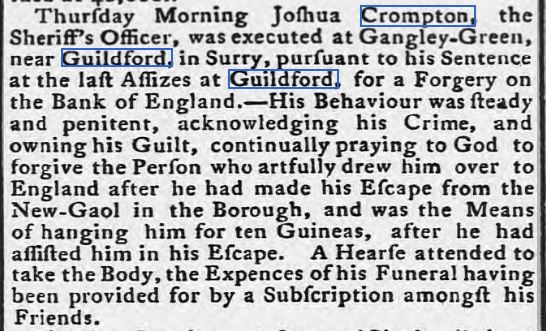
hangings in 1778 was of a man called Joshua Crompton for the crime of forgery.
At a time when there were a considerable number of
counterfeit notes being circulated, there is no doubt that Joshua was being used as
an example to others, but he was also a victim of extremely bad luck and
treachery after a see-saw life of prosperity and penury.
Joshua Crompton was the last born child of a family of 15 in
Bolton, Lancashire. After being orphaned
at the age of 10, he travelled to Manchester where he found work with a
gentleman’s family, eventually becoming their coachman. Also in the household was the master’s wife’s
sister, who in Joshua’s own words, “had conceived a partiality and tenderness
to me.” He encouraged this, resulting in
their marriage, which brought him a small fortune. Returning to Bolton, Crompton opened up an ironmonger’s
shop but this failed so he moved to Liverpool where he became a Sheriff’s
Officer, a respectable position.
 |
| Red Lion Square, London |
But Crompton, unwisely, became infatuated with a young woman
and they moved to London together to open up a shop in Red Lion Square. Having persuaded his mistress to return to
Liverpool and giving up the shop, he was sworn in as an officer to his Majesty’s
Palace Court, where he dealt with debtors, but ironically by 1775 he had to
quit this position because he was in debt himself to the tune of £1500. He was
also concerned about the delicate state of his wife, who was, “lying in.”
Despite his insolvency he managed to purchase the position of
Sergeant of mace, when his actions brought him into more trouble. Meeting with friends in May 1777, he planned
visits to the races at Newmarket, Epsom and Guildford Down. According to Joshua, his successful winnings
at Epsom Downs were put in his pocket book and two days later he needed to buy
some new boots. While in Mr Gaskin’s
shop, he was tempted to buy a new gown for his wife. In fact, he decided on four gowns, giving a
twenty pound note for the payment of four pounds, thirteen shillings. Mr Gaskin needed to change the large note at
the neighbouring Spread Eagle and after receiving the balance, Crompton
returned to London.
On May 20th Crompton set out for Guildford with
his friend Richard Wiltshire but the inclement weather tempted them into a
Taproom at Ewell. There Mr Peckering,
the landlord, spoke of the dire experience of his acquaintance Mr Gaskin, in
Epsom, who had recently been passed a counterfeit £20 note. The two men continued to Guildford where they
arranged a room at the White Horse before drinking in the Red Lion. Hearing next morning of the arrival of the
Bow Street Runners in the town, Joshua ordered his horse and returned to London
where he told his tale to the landlord of the City of Bristol in Wapping. He managed to board a vessel for Scotland,
arriving in Dundee on May 31st.
But two days later, he was arrested there by the Runners who had
travelled non-stop in response to a tip-off.
 |
| Sir John Fielding |
In London, Crompton was examined by Sir John Fielding and
confined in the new prison at Clerkenwell, before being moved to Newgate
prison. He had given testimony against
three other men who had assisted him, including a leading Tea-dealer near Tower
Hill and his friend Richard Wiltshire, who was apprehended. Prior to his trial in Surrey, where the
offence took place, Crompton was moved to the new gaol, Southwark.
At this point, his friend, Francis Crooke suggested the possibility
of escape. Dressed in woman’s clothing
he walked boldly out of the gaol and later he crossed the sea to Flushing in
Holland. There he picked up his life and
was doing well in the smuggling business, but Crooke suggested he return to
England, saying that he had obtained a pardon for Joshua. In reality, the aptly named Crooke had negotiated
a two hundred pound reward from the bank and one hundred from the gaol Keeper.
On July 29th 1778, Joshua was taken to Guildford
for the trial. Several witnesses gave
convincing accounts that he had knowingly presented the note but there was no
evidence that he was responsible for the forgery. Crompton was declared guilty and was condemned
to death. Showing penitence and
forgiveness, Joshua Crompton was hanged at Gangly Green, Guildford on August 24th
1778.