Showing posts with label Victorian. Show all posts

Mrs Beeton's Book of Household Management #wwwblogs

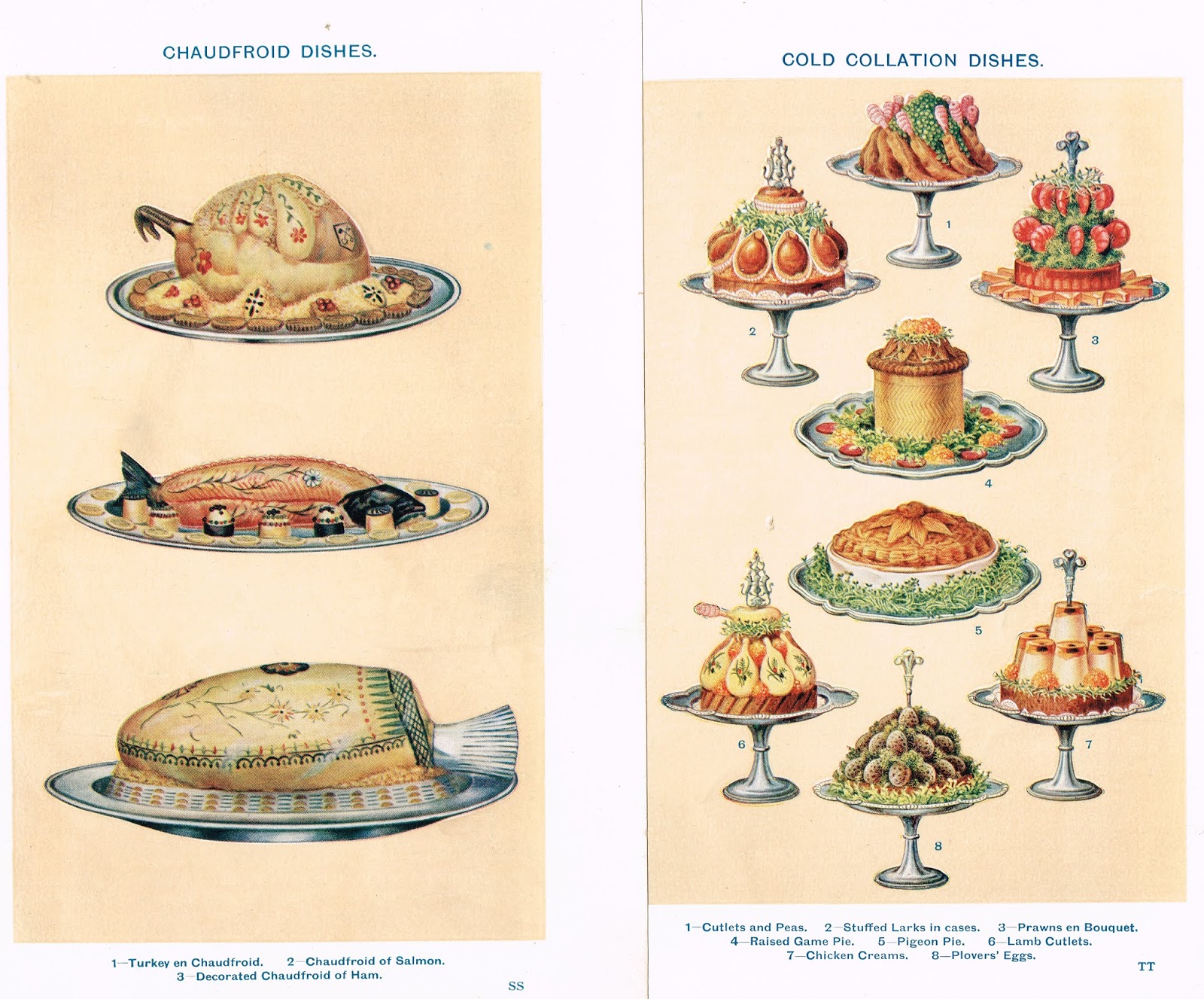
In mid Victorian times Mrs Isabella Beeton published an illustrated book to help middle class women manage their household and entertain successfully.  First published in 1861 it was a reprint of the 24 monthly installments printed in her husband's magazine.  It continued to be reprinted after her early death at the age of 28, being edited and updated as appropriate.

In 1923 my grandmother bought the latest edition, but I am not sure how much influence it had on her lifestyle.

This sunny bedroom certainly was an up to date picture, but unfortunately my grandmother had inherited Victorian furniture. Watch out for those "noxious gases" from the waste pipe!


Perhaps my father's nursery looked like this, but I doubt it.


These impressive displays look as though they came from the original edition and I seriously doubt that my grandmother and her daily maid could achieve such a banquet.

To read about Isabella Beeton go to https://paulineconolly.com/2016/truth-isabella-beeton/

#LouisWain - The man who drew cats

Both my grandmother and my mother collected postcards of cats painted by Louis Wain.


Many of these are of appealing cats with large eyes.  However Wain did not begin his artistic career with cats.  Born the son of a textile trader and embroiderer in Clerkenwell, he lost his father when he was 20 but continued to live with his French mother and his 5 younger sisters for most of his life.  He worked for newspapers such as the Illustrated london News, drawing detailed pictures of English country houses and livestock at agricultural shows.


When he was 23 he married his sisters' governess, Emily Richardson, but sadly she died 3 years later.  While she was suffering from breast cancer she took great comfort from the company of a stray black and white cat which the couple had taken in.  Louis began to draw the cat, eventually publishing his first cat picture in 1886.


Wain illustrated one hundred children's books during his life.  He considered taking up illustrating dogs but decided to experiment with his cat pictures.


At first the cats stood on four legs, but soon they walked upright and wore clothes, which was a popular motif of the day.  They always exhibited exaggerated expressions.  The postcards have always remained popular and from 1901-1915 the Louis Wain annual was published.


Louis had poor business sense and struggled financially to support his mother and sisters.  In the 1920s his behaviour became erratic and occasionally violent so in 1924 his sisters had him committed to the Pauper Ward of a mental hospital in Tooting.  A year later, at the instigation of the Prime Minister, Wain was transferred to Bethlem Royal Hospital where the garden included a colony of cats.


It was said that Louis Wain suffered from schizophrenia and that this could be seen in the bright colours and highly patterned cats he produced in his later years, but it now believed that in fact he had Asperger's Syndrome.  None of his pictures were dated and some argue that if these were his later drawings, they were evidence of his experimentation and artistic maturity.

One thing is certain; you either love them or hate them.


#Poisoning of baby Charlotte Langford


Early on a Monday morning in April 1869 George Coker, an apprentice chemist, collected the key to Albert Langford’s Chemist and Druggist’s shop in King's Lynn from Mrs Mary Ann Langford, in her kitchen.  But soon he realised that this was not a normal day.  He discovered that Albert Langford, who had suffered from declining health for over a year, was now experiencing convulsions and facial twitching.  Dr Lowe, who knew the family, was summoned and as he attended to Albert he realised that Mary Ann Langford was also unwell.  Becoming very excited she grabbed the doctor’s hand saying, “Dr Lowe I have poisoned myself.”  “With strychnine?” asked the doctor. “Yes, and I have poisoned them,” she replied before succumbing to a violent convulsion.  Immediately Dr Lowe sent for a stomach pump and requested Dr Archer to aid him.  He also went into the shop downstairs for an emetic to treat Mrs Langford.  Only then, did he spot baby Charlotte in the arms of her sister.  Just 4 months old, she was evidently suffering the same symptoms as her parents.  By the end of the day, Charlotte had died.


Local people were stunned by these events.  Albert, like his father and brother, was an established chemist and druggist and well respected in the community.  Mary Ann, who had,” been very pretty,” was now, at 38, a mother of 8 young children and occasionally helped out in the shop; more so since her husband’s ill health.  Worried that the business was declining, she had dispensed with both her servants, adding to her considerable workload.  Since the birth of her last child she had been severely depressed and despondent and experienced severe head pain.  Her guilt seemed inevitable when a packet of white powder found in her dress pocket proved to be strychnine.


Strychnine was used as a poison for rats or birds and was sold by a chemist and druggist, being kept in sealed bottles or, once opened, within a drawer.  It affected nerves in the spinal cord causing increased sensitivity to sensory stimuli and inducing convulsions.  Death usually occurs within two hours as a result of either suffocation by paralysis of breathing or by exhaustion.  Doubt was raised in this case, since Charlotte lived for 6 hours while her mother recovered completely.  Albert Langford was nursed for 10 days before finally dying, although his convulsions had ceased.

Although reluctant to arrest Mary Ann, George Ware, Superintendent of Police took possession of sealed jars containing the contents of Charlotte’s stomach to be delivered to Dr Letheby at the London hospital for analysis.


Mary Ann was remanded in custody at Wymondham Bridewell where she tried unsuccessfully to commit suicide.  The trial was held in Norwich where Mrs Langford appeared in deep mourning.  Dr Letheby told the court that he had been able to kill a frog with the contents of the baby’s stomach.  It was suggested that Charlotte might have ingested the poison via her mother’s milk but this was dismissed since Mary Ann would have died if she had consumed enough strychnine to pass on to her daughter.

Deep mourning

Character references were given of Mary Ann’s affection towards her children and exemplary manner to her husband, even when he suffered loss of power, numbness in his limbs and incoherent speech.  Dr Lowe told of an appointment he had with the family on March 30th when Albert’s wife and mother implored him to admit Mr Langdon into an asylum but despite his weakness and loss of memory, Albert spoke rationally and, being no danger to himself or others, was not committed.

After evidence was heard from all those present on the day of Charlotte’s death, Mary Ann Langford was acquitted of murder since she had been,” of unsound mind,” when administering poison to her child.  Prosecution against her for murder of her husband was then abandoned.

Two years later Mary Ann Langford and her seven remaining children can be found on the 1871 census living just round the corner from their former home.  Mrs Langford is listed as an Annuitant which suggests some form of insurance or pension resulted from her husband’s death.  This must have been a relief since all of the children were still at school and the eldest, Edward had suffered from paralysis since birth.

A Serious Offence

On 10th October 1886, The Surrey Mirror reported that a serious offence had taken place on the premises of Guildford Union Workhouse.  Frank Maplestone Riches, who been appointed Temporary Master of the Union owing to the death of the previous Master, Mr Hardwick, was charged with embezzlement of £10, the money of the Guardians.

Mr Riches was prosecuted by the clerk to the Guardians, Mr Mark Smallpeice.  Riches had disappeared after agreeing to a meeting to go through the accounts, to look for an explanation of ten pounds 9 shillings and 6 pence which was unaccounted for.  A specific amount of five shillings paid to Mr Riches by a coal merchant was not forwarded to the Guardians.

Frank Mapleston Riches had been taken into custody in Alnwick, Northumberland, from where he was taken to Guildford for judgement.  He was found guilty of embezzlement and was sentenced to 3 months imprisonment.
The former Cuckfield Workhouse

This was a sad termination of his lifelong connection to Workhouses.  In 1861 he was living at Thingoe Union Workhouse in Bury St Edmonds where his parents were Master and Matron.  By 1881 Frank was Assistant Master at Cuckfield Union Workhouse in Sussex, where his older brother Thomas T. Riches was Master so it would have been a natural progression for Frank to become Master of Guildford Union Workhouse.  What a pity that he succumbed to the temptation of dipping into the funds to which the responsible role of Master gave him access.

Sources
British Newspaper Archive

Foul Attack by Fowl Robber

Thanks to the Illustrated Police Times I have discovered one of the dangerous escapades endured by a policeman in Victorian Kings Lynn.


In December 1889 there were a series of thefts of chickens around the town of Kings Lynn.  Chief-Constable Ware decided something should be done.  A number of his constables dressed in plain clothes and were stationed near the places where the fowls were accustomed to roost.


PC Rayner secreted himself in one of these premises and later that evening Robert Pitcher, a carpenter entered and struck a light in front of the policeman.  He admitted his purpose was to steal a fowl and he was arrested.  However on the way to the police station, he drew a hatchet from his pocket and struck the officer, “some fearful blows upon the face.”  Bleeding profusely PC Rayner struggled with the thief and managed to blow his whistle.  Aid soon arrived and the, “brutal fellow,” was taken into custody.

http://www.britishnewspaperarchive.co.uk/