Showing posts with label crime. Show all posts

Resurrection Men in Lambeth


If you have visited the Garden Museum in the deconsecrated church of St Mary at Lambeth, you have probably looked at the impressive tombs of Captain Bligh and the Tradescants.  But in the 18th century this churchyard had become so crowded, filled with approximately 26,000 bodies, a new burial ground was consecrated in the nearby High Street.  In 1814 this burial ground, now called Paradise Row, was extended, but it was not a peaceful spot to lay in rest.


Many graves were being disturbed to supply the young doctors at Guys and St Thomas’ Hospitals with fresh bodies, so watchmen were frequently employed to protect the newly buried.  In November 1817, the sexton, John Seager, employed two men to keep watch over the graves at night but the “grave snatching” continued.  Suspecting that they were not doing their job properly, John told the men one night that they were not needed, although they knew 5 people had been buried earlier in the day.


  John, his son and a young man called John Sharp, hid and after a while they heard the squeak of the gate and spotted two figures.  Two concealed man traps were set off without causing injury.  Seager recognised the men as Thomas Duffin and William Marshall, the very people he had employed to protect the graves.  Waiting until Duffin and Marshall had stolen spades from the Bone House and started to dig up a coffin, Seager and his assistants moved in to catch them.  But the robbers did not intend to be caught.  Swinging his spade, Marshall swore his intent to murder Seager and knocked him to the ground.  Seager’s son was armed with a pistol which he aimed at Marshall, shooting him in the arm.  Meanwhile Duffin swung a cutlass at Sharp who fought back with a poker.  After some time, Duffin and Marshall were taken to the Watch House where a surgeon tended their wounds and they appeared before the Magistrates next morning.


One of the Magistrates believed that the men’s actions made them subject to an archaic law which would mean the removal of their ears and branding as a punishment, but he was over-ruled.  They were kept in custody until the following August, when they were tried at the Crown Court in the Guildhall at Guildford, accused of assaulting John Sharp with intent to kill and murder.  The jury found Duffin and Marshall guilty and sentenced them to two years’ imprisonment.  Twenty years later, in 1838, John Seager died in the Workhouse, at the age of 70, and was buried in the graveyard at Lambeth High Street where the struggle had taken place.  Only two years later, 60 year old Thomas Duffin was also buried there.


The rise and fall of Joshua Crompton #18thCentury

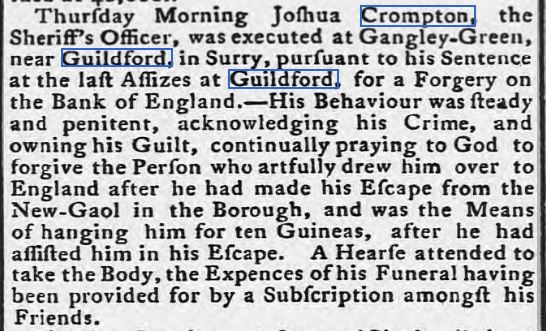
In a 1950s housing estate on the outskirts of Guildford, there is a tiny trace of the old woodland, once called Gangley Common, where executions took place.  One of those hangings in 1778 was of a man called Joshua Crompton for the crime of forgery.


At a time when there were a considerable number of counterfeit notes being circulated, there is no doubt that Joshua was being used as an example to others, but he was also a victim of extremely bad luck and treachery after a see-saw life of prosperity and penury.

Joshua Crompton was the last born child of a family of 15 in Bolton, Lancashire.  After being orphaned at the age of 10, he travelled to Manchester where he found work with a gentleman’s family, eventually becoming their coachman.  Also in the household was the master’s wife’s sister, who in Joshua’s own words, “had conceived a partiality and tenderness to me.”  He encouraged this, resulting in their marriage, which brought him a small fortune.  Returning to Bolton, Crompton opened up an ironmonger’s shop but this failed so he moved to Liverpool where he became a Sheriff’s Officer, a respectable position.
 
Red Lion Square, London
But Crompton, unwisely, became infatuated with a young woman and they moved to London together to open up a shop in Red Lion Square.  Having persuaded his mistress to return to Liverpool and giving up the shop, he was sworn in as an officer to his Majesty’s Palace Court, where he dealt with debtors, but ironically by 1775 he had to quit this position because he was in debt himself to the tune of £1500.   He was also concerned about the delicate state of his wife, who was, “lying in.”

Despite his insolvency he managed to purchase the position of Sergeant of mace, when his actions brought him into more trouble.  Meeting with friends in May 1777, he planned visits to the races at Newmarket, Epsom and Guildford Down.  According to Joshua, his successful winnings at Epsom Downs were put in his pocket book and two days later he needed to buy some new boots.  While in Mr Gaskin’s shop, he was tempted to buy a new gown for his wife.  In fact, he decided on four gowns, giving a twenty pound note for the payment of four pounds, thirteen shillings.  Mr Gaskin needed to change the large note at the neighbouring Spread Eagle and after receiving the balance, Crompton returned to London.

On May 20th Crompton set out for Guildford with his friend Richard Wiltshire but the inclement weather tempted them into a Taproom at Ewell.  There Mr Peckering, the landlord, spoke of the dire experience of his acquaintance Mr Gaskin, in Epsom, who had recently been passed a counterfeit £20 note.  The two men continued to Guildford where they arranged a room at the White Horse before drinking in the Red Lion.  Hearing next morning of the arrival of the Bow Street Runners in the town, Joshua ordered his horse and returned to London where he told his tale to the landlord of the City of Bristol in Wapping.  He managed to board a vessel for Scotland, arriving in Dundee on May 31st.  But two days later, he was arrested there by the Runners who had travelled non-stop in response to a tip-off.
 
Sir John Fielding
In London, Crompton was examined by Sir John Fielding and confined in the new prison at Clerkenwell, before being moved to Newgate prison.  He had given testimony against three other men who had assisted him, including a leading Tea-dealer near Tower Hill and his friend Richard Wiltshire, who was apprehended.  Prior to his trial in Surrey, where the offence took place, Crompton was moved to the new gaol, Southwark.


At this point, his friend, Francis Crooke suggested the possibility of escape.  Dressed in woman’s clothing he walked boldly out of the gaol and later he crossed the sea to Flushing in Holland.  There he picked up his life and was doing well in the smuggling business, but Crooke suggested he return to England, saying that he had obtained a pardon for Joshua.  In reality, the aptly named Crooke had negotiated a two hundred pound reward from the bank and one hundred from the gaol Keeper.


On July 29th 1778, Joshua was taken to Guildford for the trial.  Several witnesses gave convincing accounts that he had knowingly presented the note but there was no evidence that he was responsible for the forgery. Crompton was declared guilty and was condemned to death.  Showing penitence and forgiveness, Joshua Crompton was hanged at Gangly Green, Guildford on August 24th 1778.