Home Entertainment in the 1950s: "I love to go a wandering" #Nostalgia


For the first 10 years of my life we lived in a terraced house in a long cul-de-sac in a part of Surrey which now seems to be called south London. It was a quiet road where you could play on your scooter or your roller skates on the pavement and nobody owned a car. Downstairs we had a Front Room, nicely furnished for use at Christmas or occasional Saturdays when my grandparents arrived in a taxi for tea.

At the end of the hall was the Living Room where we spent most of our time. There was a coal fire with three comfy chairs, a utility dining table with 4 chairs and a sideboard on which the very important Wireless sat. That’s a radio if you are unsure.

My early memories include Listen with Mother where I heard songs such as “One, two, three, four, five; Once I caught a fish alive” and I could march up and down the hill with "The Grand Old Duke of York". Rhymes like "Mary, Mary, Quite Contrary" growing neat rows of silver bells and cockleshells and the King of Spain's Daughter with her "Little Nut Tree" which only grew a silver nutmeg and a golden pear were also shared. "Polly Put the Kettle On, We'll All Have Tea”, Seemed to end most of the programmes!

On Saturday Children’s Favourites was presented by Uncle Mac, playing such songs as, The happy Wanderer, Arthur Askey's Bee Song, Nellie the Elephant, The Runaway Train and How much is that doggy in the window? My real favourite was a song often played on the adult part of The Light Programme. I called it My Scots Blue Bell, but apparently it was really called “I Love a Lassie” by Harry Lauder. I also enjoyed hearing “I love to go a Wandering” The only programme I can remember from Children’s Hour on weekday afternoons was the wonderful Larry the Lamb who lived in Toytown.


Sometimes at lunchtime my mother and I would listen to Workers' Playtime which was a variety programme started during World War II. It was broadcast at lunchtime, three times a week, live from a factory canteen "somewhere in Britain". It included singers and comedians like Ken Dodd and Julie Andrews. Later my mother listened to Woman’s Hour which apparently included items on, “keeping house, health, children, beauty care and home furnishing and interviews with women of note such as Vera Lynn.”

There had to be a daily dose of The Archers, “an every day story of country folk,” and I can still hear the voice of Mrs Dale from Mrs Dale’s Diary telling us in her catchphrase, "I'm rather worried about Jim..." 

There were some great comedy programmes including The Navy Lark including actors still well remembered today, Ronnie Barker, Jon Pertwee and Leslie Phillips. My particular favourite was The Clitheroe Kid because he was so naughty. But when Dad was at home he often tuned off the Light programme onto the Home Service for the news and weather.

We also spent hours as a family playing Cribbage, Canasta, Snakes and Ladders  or Monopoly but as I was an only child, I usually won.

And then the television arrived. In 1957 only two children in my class no longer had a TV at home, a boy called Paul and me! But my parents succumbed. Now I could watch the wonderful cartoon about Popeye the sailor man, his girlfriend Olive Oyl and the miraculous cans of spinach which made him strong. I also enjoyed westerns like Rawhide and Bonanza, but Bonanza went on till 9 o'clock and i was supposed to go to bed at 8.30. Luckily my mother started to go to an Evening class that night and Dad let me stay up to see the end of the programme!  There was usually a children's serial on Sunday afternoon on BBC like The Silver Sword or Great Expectations but then I was told we had to turn the TV off to let it cool down before Sunday Night at the London Palladium with Bruce Forsythe so I wasn't allowed to see Adam Faith or Cliff Richard in the Oh Boy! programme.

Those were the days!

Linferd Ware: My missing Great Uncle


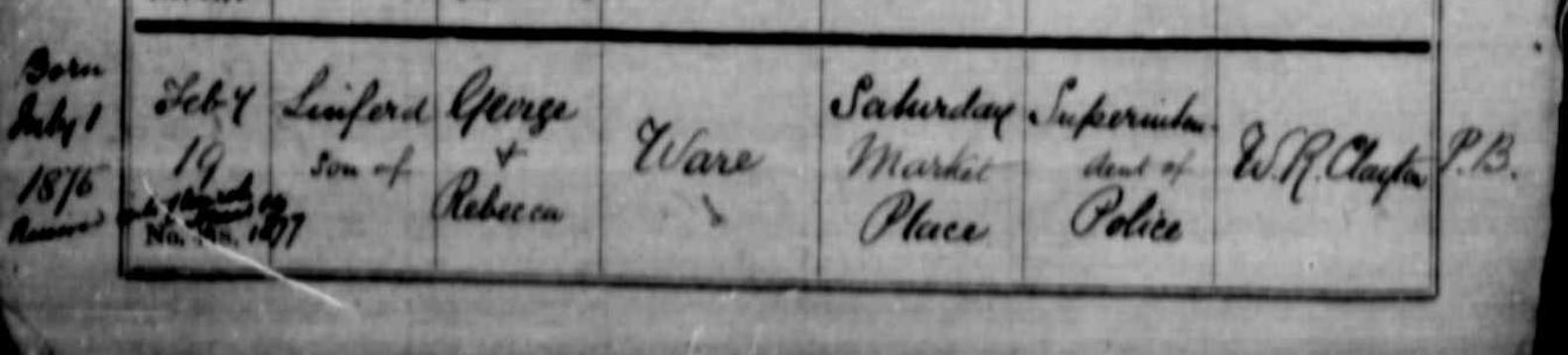
Linferd Ware was the Great Uncle who most intrigued me and until this week he was also uncompleted, a brick wall. He was the third child of my Great Grandfather George Ware and his second wife, Rebecca Linferd, born on July 1st 1875.  Like all their children he was born above the Town Hall in the Saturday Market Place Kings Lynn. This was because his father was Police Superintendent based in the Town Gaol next door.


Linferd’s story reads like the life of an over-active butterfly. By the age of 15 he was living in Regents Park Barracks in London as a Bandsman in the First Lifeguards Brigade. The life obviously didn’t suit him so with his father’s help he purchased a discharge for £18 and soon after returning home he joined the Lynn police.  There were suggestions of nepotism when he was soon given more responsibility, so he moved to the police force in Nottingham where he worked as a young detective constable. However by 1895 he was attracted to the military again, this time joining the Royal Dragoons, once again as a musician. He was now aged 21, 5 foot 10 inches tall, weighing 137 lbs. He had hazel eyes and dark hair. This time he remained in the army for 3 years before once more purchasing his discharge.  Later that year Linferd Ware married Katherine Clarke (Kitty), daughter of the Kings Lynn Dock Master. At that time Linferd is listed as a Coal Merchant.


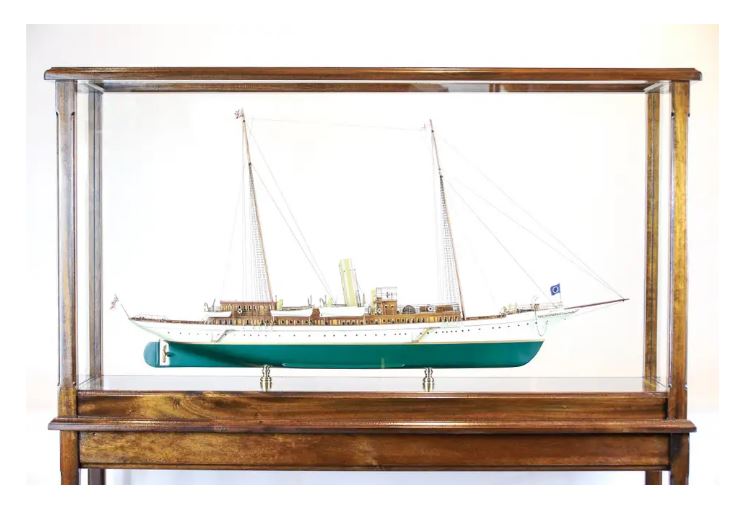
Linferd appears twice in the 1901 census. Once with his wife living in the centre of Southampton, occupation musician and Ship steward and in the other entry he is named as a steward aboard the steam yacht, Erin, lying off Hythe in Southampton water.  The Erin has an interesting history. At the time it belonged to Sir Thomas Lipton, who also owned the Shamrock II one of the entries to the Americas cup. Linferd must have been aboard the Erin on April 30th 1901 when it towed Shamrock II to New York.


A Model of the Steam Yacht Erin


After that I was unable to find any trace of Linferd though I suspected a death when he was not named in his father’s will in 1911.  Finally, I found a small death report in the Lynn Advertiser saying that Linferd Ware had died in the Memorial Hospital in Bulawayo, in the Eastern Cape in September 1909 aged 34.  I believe his wife Kitty was with him as Katharine Ware is on the passenger list of a ship sailing from Cape Town to Southampton in 1912.


Travelling through my Early Life #WWWblogs

Spending most of this year not travelling but staying at home has made me think about how I travelled during the first 20 years of my life.  At the time I was born in Scotland in 1950 the plough on my Grandparents farm was pulled by two horses. Here is my Gran with Dick and Donald.


For the rest of the 1950s I lived in a terraced house in Mitcham in Surrey, which is now considered to be south London. I don't think anyone in our road had a car but we had milk delivered by the Co-op electric milk float and bread by this horse and cart. Coal was delivered in sacks carried along an alley to the back of the house and from time to time the rag and bone man or the knife grinder would call round. The street lamps still ran by gas, switched on each evening. To go to central London, my father would catch a bus to his office, while my mother and I would sometimes take a trolleybus to Croydon or take the bus to Tooting for the underground into London.


We moved away from Surrey in 1961 and so I didn't ride on another trolley bus till 1968 when I arrived in Reading, Berkshire to discover they still had trolley buses.  Meanwhile in Glasgow on holiday I was able to ride on trams for many years.


Like most people I travelled on school buses and eventually my father learnt to drive and bought a car.  A succession of Fords ended with me buying his old Ford Corsair.


Prior to that, in 1966 we had sailed to Singapore, where we lived for 3 years, on the P & O Cathay, a 14000 ton ship for 300 passengers. There was a small pool, films were shown and entertainment such as quizzes and music were offered. Going through the Suez Canal was an interesting experience but this stopped in 1967 due to the Arab Israeli war.  


After 3 years we returned via Australia and South Africa on P & O Himalaya, a much larger ship taking 1416 passengers. It was full of young Australians going to Europe for a year and elderly British people returning after visiting their families who had emigrated to Australia.


While I lived in Singapore we took a mini cruise to Hong Kong in April 1967. We sailed there on an Italian ship the Achille Lauro which served amazing Italian food but had rather too many cockroaches in the cabins.


The Achille Lauro was to become famous for disasters. On October 7, 1985, four men representing the Palestine Liberation Front took control of the cruise liner off Egypt as she was sailing from Alexandria to Port Said The hijackers held the passengers and crew hostage and directed the vessel to sail to Syria,  demanding the release of 50 Palestinians from Israeli prisons. After being refused permission to dock at Tartus, the hijackers murdered wheelchair-bound American passenger Leon Klinghoffer and threw his body overboard. The ship headed back towards Port Said, and after two days of negotiations, the hijackers agreed to abandon the liner in exchange for safe conduct and were flown towards Tunisia aboard an Egyptian plane.

 On November 30, 1994, the Achille Lauro caught fire off the coast of Somalia while enroute to South Africa. Abandoned, the she finally sank on December 2.

I didn't sail on another ship until 2012!


Almost #WordlessWednesday Painshill Park, Surrey


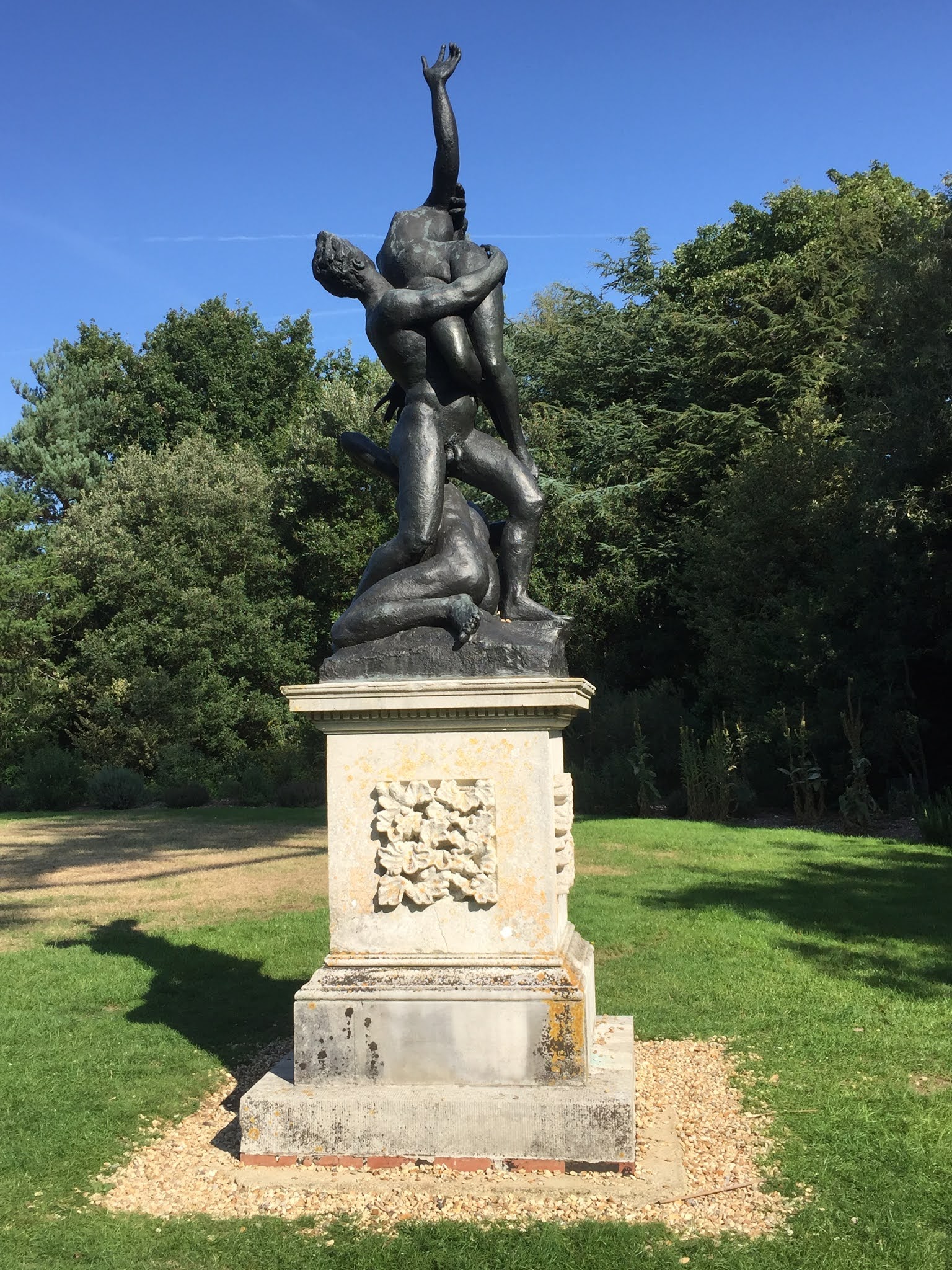
Painshill landscape garden was created in the 18th century by the Hon. Charles Hamilton. Using his experiences of doing the Grand Tour through Europe he tried to produce living paintings in a magical garden of follies. His garden attracted many visitors even before it was completed, but sadly due to his mounting debts Hamilton was forced to sell Painshill in 1773. He moved to Bath where he died just over a year later.


The Gothic Temple 


My McKinnon Family


When I started to research the McKinnon side of my family in 1999, the easiest way to access information about them was a set of CDs of the 1881 Census issued by the Church of Latter Day Saints. Here I found my great grandmother and all her siblings working as house servants (the girls) or farm servants (the boys).  Meanwhile her parents John Mckinnon and Mary Barron were at home in Petty, Inverness-shire looking after 3 illegitimate grandchildren.

The McKinnon (or MacKinnon) family originated on the islands of Mull, Coll, and Tiree n the Hebrides and later Skye and Rum.  For hundreds of years the MacKinnons held offices of importance in both the military and civil administrations of the Isles. A MacKinnon chief was the marshal of the island fleet that transported Robert Bruce and his army at the start of the campaign that ended at Bannockburn in 1314. MacKinnon chiefs were respected members of the Council of the Isles and from 1357 until 1498 the MacKinnon clan supplied the abbots and priors for the monastery on Iona.

After the Act of Union between England and Scotland, Clan MacKinnon supported the Jacobite cause especially in 1715 and 1745. Following those failed uprisings, the clan members were reduced to poverty. Their land was sold off and many emigrated. The Highland Clearances, moving people to make room for sheep, caused more McKinnons to scatter round the globe.

The first McKinnon we can trace in our family is William MacKinnon, a weaver, living in Stronaba, Kilmonivaig, Invernesshire.  He and his wife, Ann Cameron had two children, Christian (female) and John MacKinnon. By 1841 William had died and Ann McKinnon (Cameron) was in misery (on charity). In 1851 she was listed as a parish pauper. Later that year John, a labourer, married Mary Barron, a servant maid working at Glenfintaig House, in Kilmonivaig. 

John McKinnon and his wife Mary, who spoke Gaelic and English, soon moved to Elgin, Moray where their first 2 children were born, but by 1854 when their son William McKinnon was born, they were living in the village of Petty on the edge of the Moray Firth near to the town of Inverness.  John worked as a railway surfaceman until he died of a heart attack aged 82. His wife Mary Barron died 8 years later in Inverness and was buried at Tomnahurich Cemetery in Inverness.  Of the 10 children of John McKinnon and Mary Barron, my great grandmother Eliza was their 6th child.


Eliza was later called Elizabeth. Her son Alexander Stewart was born in 1879 when she was 17. By 1881 she was working as a nursemaid in Inverness but at some point, during the next 7 years she moved to work in Dunbartonshire over on the west coast. There she met Northern Irishman, Robert John Hughes, a mason, but by the time they married in 1888, he was a postman. On the 1891 census they are listed living in the village of Row (Rhu) on the Gareloch. The couple had 9 children including Elizabeth Hughes, my grandmother born in 1900. Of Eliza McKinnon’s 7 sisters, two, Catherine and Mary, moved to Australia with their husbands, the two brothers, William and John, were farm labourers and Johanna never married.

Eliza McKinnon

The Sad Tale of the Paupers Nobody Wanted : Proving the right of a British Citizen


In recent years, recent days even, we have heard people in this country denouncing refugees crossing from France because, “the British Taxpayer has to provide for them.”  In 1834 the government passed the New Poor Law to reduce the burden on the rate payers in England of providing for paupers with out relief by replacing it with indoor relief within the Union Workhouse.  The old rules of Settlement, where birth in a parish was necessary to receive help no longer applied so clearly but gradually the right of aid within a union of parishes was established.

However, in one sad case in Surrey and Hampshire no rights of support were legally allowed. It concerned a family where the wife, Catherine Stringer, had been born in Prussia (Germany), the daughter of a British soldier, and her husband, Michael Stringer, the son of a freed slave who had been born in Jamaica was considered a foreigner even though he received a soldier’s pension after more than 20 years’ service in the British army.

In November 1854, Catherine Stringer, who with her husband, Michael, had given birth to 14 children, presented herself at Guildford Union Workhouse, with her youngest 3 children because her husband had seduced their adopted orphan child, who at 18 was expecting his baby. Catherine was a British subject in every census record but had no right to poor relief.  Her husband was stationed in the barracks in Guildford, but when the Guildford Board of Guardians discovered she had a son-in-law in Portsmouth (where Catherine had once lived) who could take her in, they bought her train tickets so she could remove herself and her youngest children to Portsea.  Mr Ames, Master of the Workhouse took them to Guildford station and accompanied them in the carriage to Woking station where he put them on the Portsmouth train.

Subsequently the Poor Law Board in London ruled this removal from Guildford to Portsmouth was illegal.

Michael Springer is described on his pension documents as 5 ft 8 inches tall with dark brown hair, grey eyes and a swarthy complexion. He had a good military record and was a Sergeant as well as a Bugle Major. He retired aged 38 because of arthritis, probably caused by many years of service in Ireland after his upbringing in the warmer climate of Jamaica where he was born. In 1821 Michael married Catherine after meeting her in Halifax, Nova Scotia, where her father was also serving as a soldier.

Michael had served as a Bugle Major for 19 years with the 2nd Battalion 60th Infantry Regiment but prior to that he had enlisted in Jamaica at the age of 12. After being discharged in Ireland in 1834, where many of his children were born, he moved to the more favourable climate of Portsmouth. Unfortunately in 1851 he was convicted of the felony of larceny, which is why the 1851 census lists Catherine as Head of the house.

On finishing his sentence in 1852, Michael joined the Surrey Militia in Guildford until his discharge in 1854 when like his estranged wife he moved back to Portsmouth where some of their adult children lived. Soon his itchy feet took him back to Cork in Ireland but in 1861 Catherine is still in Portsmouth with some of her children.


I believe Michael remarried in Cork, probably bigamously but in 1875 Catherine died in poverty in the Union Workhouse on Portsea Island.


The problems the couple had in establishing rights as British citizens despite valid parentage, being born abroad as a result of her father's army service and in Michael's case owing him reward for his duty to Britain as a soldier, reflect the experiences of the Windrush generation and also of the difficulty experienced by some of my generation in obtaining a British passport because they were born in Singapore or Malaysia due to their father's military service. No wonder they had such tempestuous lives.