Great Dunmow #Genealogy #EssexChurches

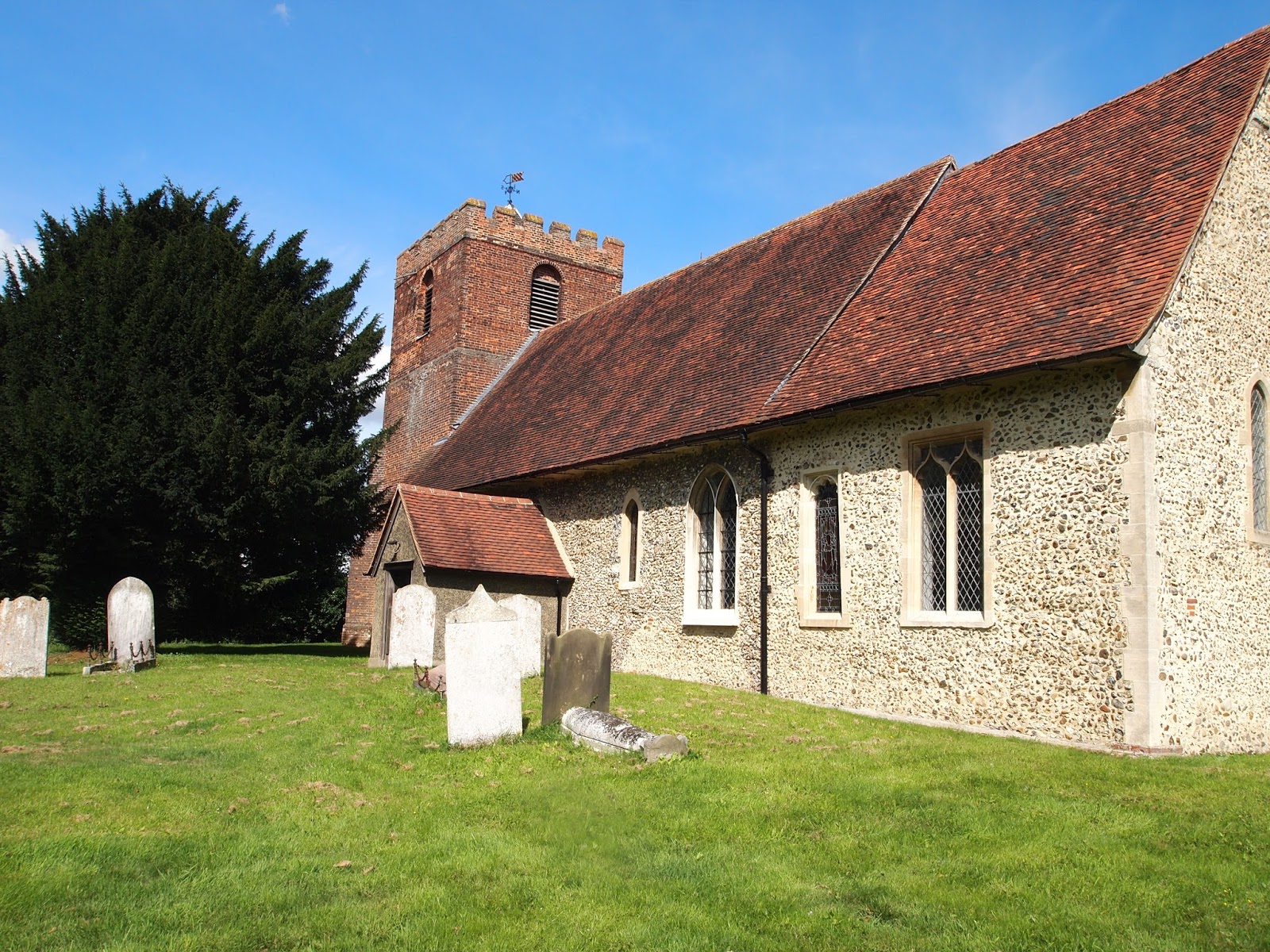
I recently visited Great Dunmow, in search of the church where some of my ancestors worshipped.  After parking in the centre we discovered that the church is on the edge of the small town, some twenty minutes away, but this gave us the opportunity to see the lovely Doctors Pond and some of the beautiful pargeted cottages.

.

The church is set in a very large graveyard with pleasant walks to the river and rabbits scampering among the graves.


Inside there are some stunning modern stained glass windows.


I was thrilled to find these small monumental brasses half hidden behind an altar near the west tower.  I learnt about them from "The Glasscock Families" by Rev. Laurence Glasco.  I have my distant cousin Barbara in America to thank for sending me copies of pages from his book.  We know they relate to our family as they show the crest of the Glasscock family, many of whom were early emigrants to America.


Although there are many beautiful carved tombstones around the church I was unable to decipher them.


These chubby faced cherubs probably date from the 18th century.


Two Essex Village Churches #MondayBlogs

Last week I visited seven of the churches in rural Essex where members of my family were baptised or buried.  These are the first two which we saw.  Sadly only one was unlocked.  Moreton is one of the many villages which are reached by small winding lanes, but the church includes architecture from pre-Norman times with changes and additions over the years.  Originally built of flint and clunch, a soft, chalky limestone, the walls have been strengthened by replacing the clunch with more durable stone.  The tower is built in red brick with a lower shingled spire and there is a typical Essex wooden weather-boarded porch.  The windows date from the 15th, 18th and 19th centuries.

St Mary's Church, Moreton


There was a tradition of Dissenting Ministers in Essex so it was a pleasure to find this memorial to Rev. S. Gaffee.


St Mary the Virgin, Matching is reached by driving along a single track road past a beautiful pond.  The village has changed very little since the 18th century.

St Mary the Virgin, Matching

This was the smartest church we visited, mainly due to the owners of nearby Down Hall who gave £3000 for its improvement in 1875.  Probably a Norman church, on the site of a former Saxon church, it has a 13th century doorway and a 15th century tower.


The signature of William Dearling MA vicar from 1761-1784 is written in the Prayer Book given to my ancestor Bartholomew Glasscock who was churchwarden in Matching.


.


This window is dedicated to Sir Henry and Lady Selwin-Ibbetson of Down Hall, who supported the church so well.

LES MARCHÉS NOCTURNES


One of the delights of July and August in central France are the night markets held on different evenings each week in nearby towns and villages.


Stalls are set up laden with olives and mussels.  Spit roast pork is served on potatoes and beans.  Even English fish and chips are sometimes available.  Paper plates are provided but you can bring your own plates and cutlery, a bottle or two of wine and glasses.


Under the market roof, the Mairie set out tables and chairs where you can sit to eat perhaps bringing your own table cloth and napkins.  As the evening progresses there will be entertainment, perhaps music for dancing or a singer.


All around the square will be other places to eat and drink with crepes and ice-cream on sale and a few other stalls selling hats or jewellery.


As it grows dark people begin to return home and even the cats retire for the night.


Guerilla Knitting in The Algarve #WordlessWednesday

Every other year, the Algarve town of Quarteira celebrates the sea and its fishermen with crochet and knitting out of doors.


#PastMeetsPresent in Guildford

I recently bought a book of old 19th century pictures of Surrey views, collected and printed by Charles W Traylen, a bookseller, who lived and worked in Guildford from the 1920s until his death in 2002.  There are 24 reproductions of pictures around Surrey which include the following Guildford views.


As you can see Guildford hasn't really changed very much.

The Guildhall at night


I can't really reproduce this picture today as there is now a block of flats in the foreground so here is a photo looking from the opposite direction half way down the High Street.


And Abbot's Hospital is still providing a home for the elderly who were born in Guildford as Archbishop George Abbot wanted it to be.

Footnotes on the Artists

George Sidney Shepherd, who painted the view of Abbot's Hospital, was the son of a watchmaker who lived in London.   By 1800 he was exhibiting watercolours at the Royal Academy and he specialised in townscapes and scenes of London.  Although very successful, he spent his last years in poverty and died in a workhouse.

Charles Claud Pyne was a watercolour artist and Art Master at the Royal Grammar School in Guildford.

#PastMeetsPresent is inspired by Becky B.  Here is her July post from Portugal https://delightsofthealgarve.com/2017/07/01/algarve-salt-production/