For other #SixWordSaturday posters:-
Cee’s Which Way Photo Challenge #SundayBlogShare #Photography
Cee’s Which Way challenge is all about capturing the roads, walks, trails, rails, steps, signs, etc. we move from one place to another on. You can walk on them, climb them, drive them, ride on them, as long as the specific way is visible. Any angle of a bridge is acceptable as are any signs.
I found it via Cathy on Between the Lines
Mine was our journey home in October.
Girls from the Workhouse #MondayBlogs
As a common rule, girls of fourteen are hired out of the workhouse by persons who are in need of a cheap drudge. They get wages that will scarcely buy them clothes ; are overworked ; are left untaught or ill-taught, to become weary, slovenly, and out of heart with life ; are often left much alone, while their employers, who themselves must drudge, are absent at their place of work. These poor little girls break down and are discharged.
Charles Dickens
Emmeline, daughter of Lord Stanley of Alderley in Cheshire,
was born with a silver spoon in her mouth. She married Albert Way, a man of means,
wealth and property and was able to use her money and influence to help the
less fortunate. As Albert indulged his
interest in antiquaries and founded the Archaeological Institute, Emmeline
turned to philanthropy.
The Honourable Mrs Way was particularly concerned about the
plight of young women leaving the workhouse, who would seek employment as maids.
without the experience or refinement to achieve a good position. Near to her home in Wonham Manor, Surrey, she
set up Brockham Home for orphaned girls from Workhouses all over the country,
so that, as she later told the Poor Relief Committee of the House of Commons, the
girls should have, “just the training that they would receive from a very good
mother.” Beginning in 1859 with a group of orphaned girls aged 11 to 16, Mr and Mrs Way opened a Nursery Home for 14 infants, as a birthday present for their daughter in 1872. Eventually
both Homes were amalgamated under one Matron. The girls were trained to work in middle-class households, rather than
becoming the lowly, spurned, workhouse skivvy in a large household.
The Honourable Mrs Way used her contacts and influence to instigate the
Pauper Education Act, in 1863, which made it possible for Local Authorities to
pay from the Rates for children to live in homes, including the Brockham Home,
but at a rate not more than the Authority would pay to the Workhouse. The girls were to have:
3 pairs drawers, 2 skirts, 4 brown holland pinafores, 2
night-gowns, 4 pairs stockings, 1 jacket, 3 shifts, 4 handkerchiefs, 1 hat, 2
pairs stays, 2 pairs boots, a brush and comb, 2 flannel petticoats and 3 frocks.
Among the orphans listed living at the Brockham Home in 1881, were sisters Fanny Huggett, age 7 and Jane Huggett, age 8, both born in Milford,
Surrey. Their training was successful, as
in 1901 Fanny can be found working as a cook in Hastings to Agnes Barker, who
lived on her own means and by 1911 she was still a cook but one of 6 servants
working for a family in Sunningdale. Her
sister, Jane, was provided with an outfit to the extent of 30 shillings for her
job as a cook, working in Kent in 1891.
But while these orphans were staying at the Home as children, their
laundry was cleaned by a mother and daughter, Harriet Hammond, a 45 year old
widow, and Edith Hammond, age 19, both from Hambledon near Godalming. Ten years later Harriet was working as a Sick
Nurse in Bermondsey, but by 1901 she was a resident of Guildford Union
Workhouse, where she died two years later.
The Hambledon Poor law Union Minutes tell a sad story about
Alice Legge whom they sent to Brockham Home in 1893. The Medical Officer for
the Home reported that Alice was suffering from opacity of the cornea and a
piece of thorn had been removed from her eye. An Order for admission to Royal
London Ophthalmic Hospital at Moorfields, was arranged by the Poor Law Board of
Hambledon. Later that year a letter was
received from Brockham Home saying Alice Legge must return to Hambledon Workhouse
suggesting she should be at the seaside and have good nourishment. The board resolved to send her to the Seaside
Convalescent Home at Seaford at a cost of one guinea. However, it was considered better to send her
to the Metropolitan Infirmary for children at Danes Hill ,Margate. After 5
months, the Home in Margate considered that Alice could now be removed. After a year’s training at the Brockham Home,
Alice was sent out to service with Mrs Marshall, wearing her 30 shilling uniform, but 6 years later in July 1901 Alice Legge died at Brookwood Asylum.
And what did they do with the Workhouse boys?
Emmeline Way died in 1906, age 95. The Brockham (Way) Home closed in 1970.
©Elizabeth Lloyd
And what did they do with the Workhouse boys?
The Frescoes of Allemans du Dropt Almost #WordlessWednesday
Deep in the
countryside of south-west France is the village of Allemans on the bank of the River Dropt. The inhabitants were invaded by a
Germanic tribe in the sixth century, giving Allemans its name. It is an attractive spot with half-timbered
houses, narrow streets and a very unusual church.
The Church
of St. Eutrope has been beautiful restored to reveal much of the late 15th
century frescoes on its walls. The
Romanesque building dates from the 10th century commemorating St
Eutrope, the Bishop of Saintes and 3rd century
martyr.
The frescoes, which were discovered in 1935, show
in shocking detail, the Passion of Christ, the Last Judgement and Hell, but there
is a feeling of calm in this whitewashed nave which includes bright 17th
and 20th century stained glass windows.
Creation of a new town by the seaside at the beginning of the 20th century
Did your
family move to another part of the country during the late 19th or
early 20th century? As the
middle class increased in numbers and wealth, there were many professionals or
tradesmen who could afford to give up their business in the cities and retire
to a quieter place. Frequently they chose an expanding town by the seaside.
![]() |
| West Pier, Brighton 1905 |
Originally
made popular in the mid-18th century when sea-bathing and drinking
of its water were recommended as a cure-all, in Victorian times it was believed
that the bracing sea air was ideal for those suffering from respiratory
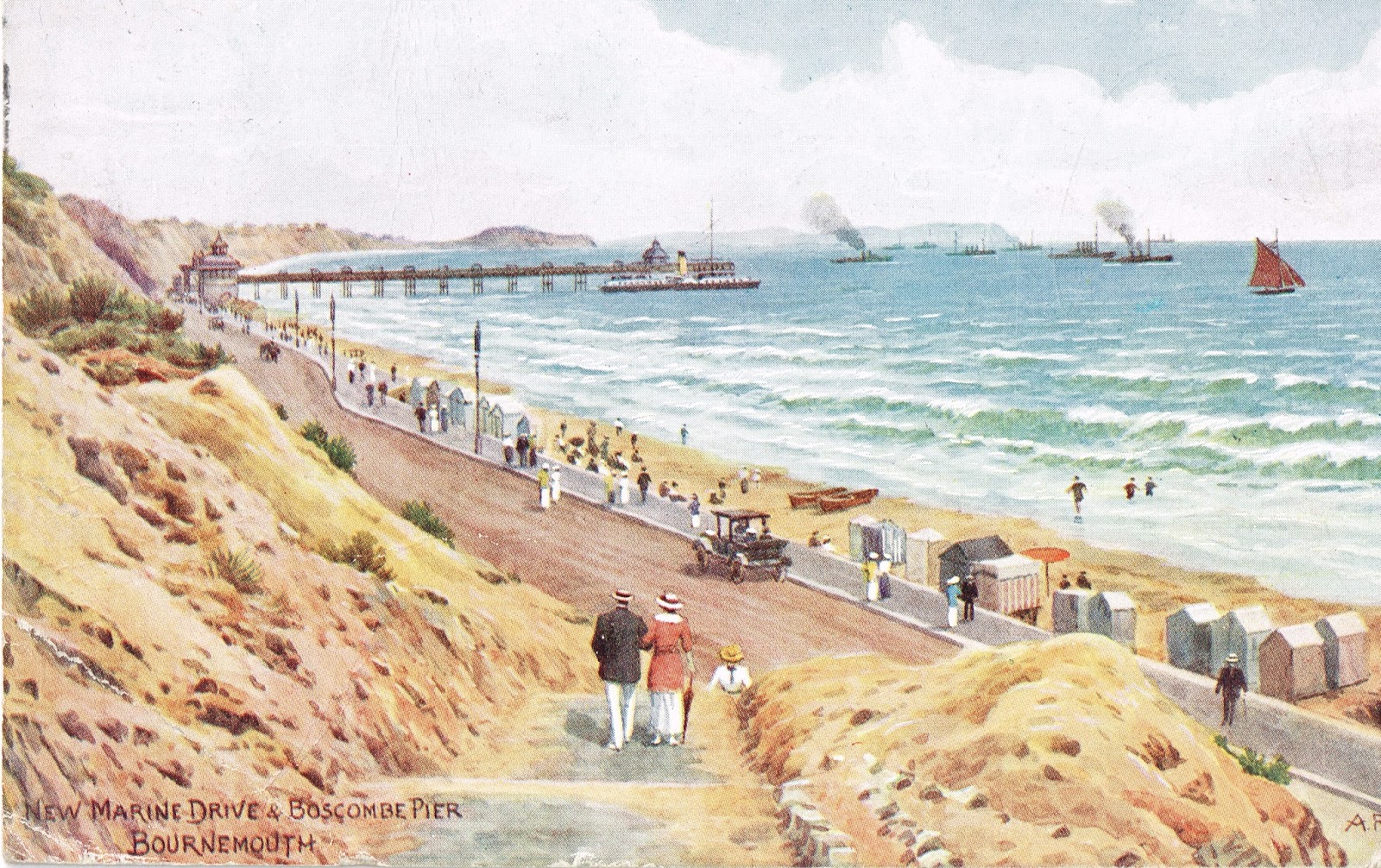
diseases such as tuberculosis as a result of living in smoke-filled cities. In consequence, in Bournemouth an “Invalids’
Walk” was laid out, connecting the town centre to the pier, which still remains
today.
My
grandparents, who were both the youngest of their family, accompanied their
parents to Bournemouth during their teens, on the retirement of their
fathers. Bournemouth had been a sparsely
populated area until the 1840s when Augustus Granville included the new town in
the next volume of his popular book on the Spas of England. Once the railway was connected to the town in
1870, high quality villas and elegant hotels were built and the population rose
from 1,707 in 1861 to 37,000 in 1891 and 60,000 by 1900.
My
grandmother continued to exchange postcards with her friends in Rotherhithe,
showing the beautiful surroundings of Bournemouth but also missing her theatre
visits in London. However she enjoyed
the musical house parties and church functions, where she met my grandfather
who, while training as an architect at Bournemouth Municipal School of Art, was
living with his father, retired Chief Constable of Kings Lynn. Two years after they settled in Bournemouth
my grandfather’s mother and sister died but a few years later his father
married a widow whom he had met in the drawing rooms of Bournemouth.
There were
in fact many opportunities for entertainment in the expanding town. In 1885 a bandstand was opened on the pier,
designed by Eugenius Birch, which had been completed five years earlier. In the summer, military bands would perform
concerts three times a day in the bandstand and as there were covered shelters
they also performed twice a day in winter.
The Bournemouth Symphony orchestra was established in 1893 and was
conducted on occasions by Elgar, Sibelius and Holst.
In Boscombe,
which attracted the wealthiest residents and holidaymakers, during the early
1890s, terraces of shops, the Salisbury Hotel, the Royal Arcade, and the Grand
Theatre were built. The famous actor, Henry
Irving brought his company to the Grand Theatre for three nights, performing
four different plays which filled the auditorium. The Grand Theatre was renamed the Boscombe
Hippodrome after refitting with furnishings from His Majesty’s Theatre in
London. At this point its range of shows
widened to include Music Hall entertainment.
An alternative venue was the Winter Gardens’ Theatre built in 1876. Between the theatres it was possible to see
Gilbert and Sullivan light operas, West End musical comedies and Drury Lane
society dramas.
In 1865,
John Sydenham, one of the proprietors of The Poole Herald, who had established
the Royal Marine Library moved it to Pier Approach, Bournemouth. There were
reading rooms containing newspapers and magazines and it was possible to borrow
books for a small
subscription. Refreshments, stationary and sheet music were also available.
On a more
practical note, in February 1877 the Royal Boscombe Hospital opened in Shelley
Road, initially with beds for 12 patients.
It was later renamed the Royal Victoria Hospital. There was a Sanatorium for those with chest
diseases and the first cemetery was established in Wimborne Road in 1877. St Peter’s church was the first to be
consecrated in 1845, but there were also religious services held in the
Assembly Rooms. Public meetings,
political gatherings and parties were also held in the Assembly Rooms and in the
adjoining Belle Vue Hotel, billiard tables could be found.
On the warm
sunny days, Bournemouth provided plenty of open space and beautiful
surroundings. Fields had been leased to
the Bournemouth Commissioners in the 1870s which were set out as Pleasure
Gardens. Wide promenades gave excellent
views of the sandy beach and the avenues were lined with trees. Before her death in June 1899, Lady Shelley,
widow of Percy Shelley the son of the poet, had gifted four acres of land which
were laid out to form Boscombe Cliff Gardens and by the turn of the century
Boscombe Chine gardens had been planted.
At Dean Park a new cricket ground was established.
The pier was
extended twice so that by 1909 it was 1000 ft. (over 300 m) long. There was a landing stage for pleasure boats
at the head of the pier while smaller craft landed on one side. The "Bournemouth Queen," a paddle steamer, commenced excursions to Swanage in 1909. On the other side of the pier there were many
bathing machines, made popular by their use at Osborne house, Isle of Wight for
the Royal family. Kept at the water’s
edge, they gave essential privacy to the bathers. Bournemouth wished to be considered a
respectable resort with no high jinks or unsuitable behaviour.
By 1910 the
boundaries of Bournemouth had expanded to include six miles of sea
frontage. Originally recommended by
Augustus Granville as, “a winter residence for the delicate constitutions
requiring a warm and sheltered locality in winter,” it had become a large
established resort for holidays, retirement and even a lifetime home for many
people.
Subscribe to:
Posts (Atom)
-
The Gaiety Theatre introduced a new style of musical comedy to London in the 1890s. The group of female dancers employed by the thea...
-
I have been trying to discover more about life for a 19 th century soldier’s wife and children to fill out the account of my great-grandfa...
-
“The most photographed woman in the British Empire” Looking through my collection of Postcards of Edwardian actresses the most stri...