Odham's Encyclopedia for Children

At the weekend I rediscovered one of my favourite books lurking in the attic.  It was a present from Santa Claus in 1958 and has rather a boring cover.


The writers of "Odham's Encyclopaedia for Children"  are not credited but its three advisory editors included  the Professor of Comparative Education at the University of London Institute of Education and the former Headmaster of Harrow School.  The book is described as, "an Aladdin's cave stuffed not with jewels but with facts, more marvellous than jewels but no less precious."

Filled with pictures and diagrams it really was a delight in the black and white world of the late 1950s.  These are the chapter headings:-

1.      Our World and Its Peoples
2.      Our Mind and Bodies
3.      Man the Discoverer
4.      Power and Energy
5.      Our Story Through the Ages
6.      How We Live Today
7.      Getting What We Need
8.      How We Enjoy Ourselves

Colourful maps display the world as it was seen from Britain at that time 


Note the industries of Britain shown above:- coal, steel and ships!


Diagrams show how things work


How our mind and body works.  This shows good and bad memories.


And the vehicles of the time have been drawn.


But the most beautiful illustrations were painted by John Rignall (1916- 2004) who also designed brightly coloured nature posters for schools and illustrated books about birds.


Little did I realise that my brand new encyclopaedia would be a source for social history 50 years later.


On a Cold Winter's Night #Barnardoboy #Canada

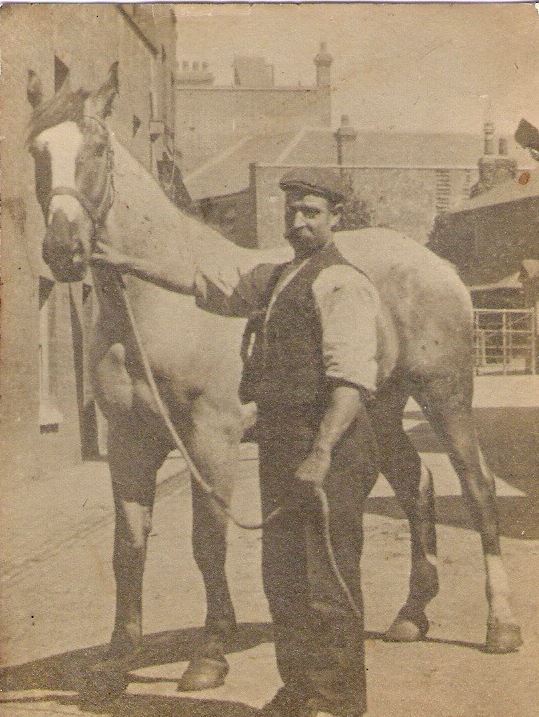
On a cold winter’s evening at the end of December 1903 Emma Fricker took a cup of coffee to her husband, Eli, while he was working in the stable which was next to their home in Friary Street, Guildford.  He was a carman, working for Mr Charles Holden, grocer.  It was necessary for groceries to be delivered regularly, by horse and cart, to the larger homes on the outskirts of town.  At 9.20pm Emma heard a noise from the stable and when she went to investigate, she found her husband unconscious, lying on his back close to the hooves of one of the horses.  Two of her neighbours carried Eli, who was bleeding from a head wound, into the house but although he groaned he did not regain consciousness.  By the time he was seen by a doctor he had died aged only 41.


Visiting Friary Street today, you will see only shops and restaurants and most of the original buildings have been destroyed, but at one end there is a trace of the houses dating from before the time when Eli and Emma lived there with their 9 children.  Another employee of Mr Holden, Thomas Lee, told the borough Coroner that he had shared a beer with Eli Fricker at 8.50 that evening in a nearby beer house and that he had warned him about one of the horses, which was prone to kick, when he returned to the stable.  All agreed that Eli seemed strong and healthy and his skull had not been fractured but his heart was in a bad condition and he was said to have died of syncope.


Mr Holden was generous to the grieving widow as Eli had been an exemplary employee and a concert was organised in the Constitutional Hall to raise funds for the Fricker family.  Despite this generosity it must have been very difficult for Emma to support her children.  Eli’s last child, Agnes Rose Fricker was born in February 1904, 6 weeks after her father’s death.  By 1906 Emma had moved to the Shambles off the High Street. Her 9-year-old son Charles Henry Fricker had been sent to Dr Barnardo’s and in 1905 he had sailed on the SS Dominion with a group of British Home Children to live in Ontario, Canada.  Her younger son William John can be found in 1911 as one of 1073 boys at the Royal Navy Training Establishment in HMS Ganges, Shotley, Suffolk.  Meanwhile most of her daughters went into domestic service.


But this was by no means the end of their stories.  Emma remarried in 1906, becoming Mrs Strange.  Charles Fricker married Pearl Teskey in 1914 and they had ten children.  He died in North Bay, Ontario in 1973.  He had been joined in Canada by his brothers Albert and William and also by his mother Emma and all three also died in Ontario.  William John Fricker had a particularly successful life.  He moved on from training school to the navy throughout World War One and was promoted to officer status in 1918.  After visiting Canada in 1923, he returned to Guildford to marry Amy Ann Lefevre in his smart naval uniform.  Lieutenant Commander William Fricker received the King’s Silver Jubilee medal in 1935 and served with the Canadian navy during World War Two.

Postscript
I have received further information from a descendent of William John Fricker. He met Amy Lefevre in North Bay, Ontario when visiting his brother Charles in Canada.  After he returned to Guildford, Amy followed some months later. The couple returned to Canada just before World War Two.


You can read more about British Home Children in my earlier blog

My Ten most popular posts in 2015

A fascinating building filled with sad stories which is well worth visiting.


Nostalgic photos of my grandparents’ farm.


A children’s occupation from the 60s and 70s.


Looking at the south bank of the Thames.


Crime on the Thames in the early 19th century


The discovery of some old letters which brought my ancestors to life.


Living in the Workhouse and emigration to Canada was the fate of these children.


The golden age of postcards show the popularity of the seaside in Edwardian seaside.


A tragic story of a soldier and his love.


An old soldier in the Workhouse


#Murder in the sand dunes

On Thursday February 20th 1908 a schoolmaster named Spurgeon was walking on the cliffs at Southbourne in Bournemouth when he noticed the clothing of a young lady between two sand hills.  On investigating he discovered that she was face down so he quickly rushed to tell the Coastguard half a mile away.  The body was that of Miss Emma Sherriff, a dressmaker, who had gone missing from her lodgings in Palmerston Road, Boscombe two days earlier.  She was found to have a muff over her face and had two handkerchiefs stuffed inside her mouth. 
Southbourne Cliff
Police investigation quickly lead them to picture dealer and ex-guardsman, John Francis McGuire, who had been seeing Miss Sherriff regularly.  Like Emma, he was in his early twenties, but according to Miss Lily Hatch, her close friend of 12 years, the relationship the couple had, was like that of brother and sister.  Emma had last been seen alive by her landlady, Mary Lane, at 1 pm on Tuesday when she seemed very distressed by a note that had been left for her.  At 6.30 Emma went out but did not follow her usual habit of leaving her key under the door mat.  On Wednesday a telegram was delivered for Miss Sherriff but as there was no sign of her, Mrs Lane forwarded it to Mr McGuire’s mother.


By Wednesday afternoon, Mrs McGuire, Miss Hatch and John Francis McGuire were outside the door of Emma’s bedroom.  McGuire forced it open but they could find no clue as to the whereabouts of Miss Sherriff.  After her body was found on Thursday an examination revealed several serious injuries caused by blows made by foot, knee or a blunt instrument.  It was later reported that some of her jewellery had gone missing.


The trial of John Francis McGuire, which commenced in late March, was full of conflicting evidence.  McGuire said that he had last seen Emma on Monday 17th February and that he had returned to his home in London on Tuesday and yet a witness saw him catch a tramcar in Southbourne at 8.12 on Tuesday 18th February, quite close to where the body had been found.  He had in fact been seen in London on the Tuesday by a shoe black who knew him well.  The shoe black stated that McGuire gave him 2 letters earlier in the day asking him to post them after 8 pm. that evening.  There was evidence that McGuire did sleep in London that night but train timetables proved that he could have caught a train to London from Bournemouth at 8.45 pm. 


There was considerable disagreement amongst the jurors and so the prosecution was withdrawn on July 2nd and the magistrate released McGuire.  Within a few days McGuire was charged at Barnet of desertion from the British Army.  He had joined the Royal Horse Artillery in 1901 but later transferred to the Royal Horse guards.  In 1904, he was court martialed for stealing a pin from a corporal’s kit and was dismissed from the army.  One month later he joined the 2nd Life guards, but deserted in 1906.  Now that he had been discovered he was imprisoned for 84 days.

McGuire may not have been convicted of murder but his life lurched from one misdemeanour to another.  After his imprisonment had ended towards the latter part of 1908 he moved to Mundesley-on-sea, Norfolk where he and a young lady took a furnished cottage.  Calling themselves Captain and Mrs Francis, they paid no rent and were soon in debt with local tradesmen.  Finally, McGuire jumped on a train to London, with no ticket, leaving the young woman destitute.  We pick up his story again in February 1909 when he was taken into custody in Westminster with another man for fraudulent conspiracy to obtain goods from a firm of house furnishers, earning himself 12 months’ imprisonment.

But what of poor Emma?  She can be found in a list of 36 unsolved murders between 1890 and 1908.  There is no doubt that John Francis McGuire was a cad and a wastrel.  He said at his trial for conspiracy that he had had no home since he was 14 (when he joined the army) but his mother was a friend of Emma Sherriff so at that stage of his life he appeared to be cherished.  Many of the witnesses at the murder trial were unreliable so no clear verdict could be declared.

http://www.britishnewspaperarchive.co.uk/

Music, comedy and #murder #EdwardianActress

Probably the most popular type of postcards to be collected in the early 20th century, were those of Edwardian actors and actresses.  It was the golden age of British theatre and just like today, everyone wanted to know more gossip about their families.


Ellaline Terriss made her London debut at the Haymarket in 1888, aged 16. She was a talented actress and singer who began her career in musical comedies.


She was the daughter of William Terriss, who after trying the merchant navy, tea planting in India and farming in the Falkland Islands, had become a member of Sir Henry Irving’s company at the Lyceum theatre.  Besides being a noted Shakespearian actor, he was also known for his swashbuckling roles such as Robin Hood. 

William Terriss
A year earlier than Ellaline, Edward Seymour Hicks also began his career on the London stage at the age of 16.  As well as becoming a popular actor he soon became a prolific author of light comedies.  The public were thrilled in 1893 when he and Ellaline Terriss were married.


In December 1897 tragedy struck.  William Terriss, who was known for his kindness, had helped out a young actor, Richard Archer Prince.  He gave Prince work but the young man proved to be unstable and drank too much, so he was dismissed.  Terriss sent Prince money and the Actor’s Benevolent Society found him another part.  However, finding himself unemployed again, Prince blamed all his woes on William Terriss, so one evening he waited outside the stage door of the Royal Adelphi theatre, carrying a knife.  When Terriss arrived, Prince stabbed him and he sadly died.  The trial was read avidly by the general public and there was a great outpouring of sympathy for Ellaline and Seymour Hicks.
 

Their popularity was immense.  During the following year Seymour Hicks co-authored “A Runaway Girl” in which Ellaline starred at the Gaiety Theatre and the couple also adopted a four year old Irish girl, Mabel Magdalene.  In 1914 Seymour Hicks recalled, “My wife saw and fell in love with the sweetest of little Irish girls, and we adopted her, calling her Mabel. To-day she is a sweet and gentle girl of eighteen, and is dearly loved by us."


In 1902 Ellaline and Seymour Hicks appeared together in Quality Street by J M Barrie.  They had recently bought a new home called The Old Forge at Merstham in Surrey and their cul-de-sac was renamed Quality Street.  Two years later Ellaline gave birth to their baby, Betty.


Edward Seymour Hicks became so successful that in 1905 he built the Aldwych Theatre and in 1906 The Globe, although at that time it was called The Hicks.  After 1911 Ellaline appeared mainly in comedy and music hall.  During the First World War, the couple gave concerts to the troops at the Front in France and in 1940 they went to the Middle East with ENSA.  Having been the first British actor to perform in France during both World War I and World War II, Hicks was awarded the Croix de Guerre twice for his services and he was knighted in 1934.


Following the Second World War, Ellaline and Edward moved to South Africa, but after the death of Seymour Hicks in 1949, Ellaline returned to England where she took up painting and had an exhibition in London.  She died in Hampstead in 1971, aged 100.

The #Edwardian Seaside #postcards


My love for the seaside began with Sunday school outings in the 1950s to places like Brighton, Eastbourne, Margate and Bognor, but the height of popularity for seaside towns was in Edwardian times at the beginning of the 20th century.

A family poses next to the beach
Many seaside resorts became popular destinations during the Victorian era when the expansion of the railways made travel accessible and affordable.  Most, but not all of the visitors, were middle class and their visits coincided with the popularity of the picture postcard. 


While sitting on a deckchair listening to the Municipal Band many young ladies and young men penned a postcard to friends and relations.  They would show donkeys, boat trips, walking en masse along the promenade or venturing along the pier to visit a place of entertainment.


There was no need to worry about getting sunburnt


and there were often beach tents or chalets for shelter


And if it rained there was always somewhere to go.


but sometimes you just needed a balmy evening.


#Postcards from a soldier #WW1

Sorting through my Grandma's postcard collection, I realised that some of the cards were all sent in 1917 from my grandfather, who was in the Royal Field Artillery, to his young son George.


My grandfather trained as an architect in Bournemouth at the very beginning of the 20th century.  In 1910 he went to work in New York, which must have been an interesting experience.  In 1912 he moved to Montreal where my grandmother travelled to marry him.  Two years later their first son was born and they probably planned to stay living in Canada.  However, after the onset of the First World War, they returned to England.  By 1916 Grandpa was a Lieutenant in the Royal Horse Artillery.  While training at Catterick Camp, he sent several postcards of nearby Richmond in Yorkshire to George and to his wife Connie.


Some of the postcards used patriotic propaganda about the country's brave young men.


Others showed the history of the Royal Artillery.


The motto Ubique reflects that "wherever" the British Army fought there would be members of the Royal Artillery.   Quo fas et gloria ducum means "where right and glory lead."

My grandfather survived the war but he was gassed so this might explain the following two pcs.


The second card shows a soldier wearing hospital blues so that anyone seeing him would know that he had fought and was not a shirker.

The following postcard was sent in December 1917 from an army post office in France.


Finally here are two of the beautiful silk embroidered cards which George received.


Which show the badge my grandfather wore on his hat.


My grandfather returned home safely.  His son George died of peritonitis in 1924 aged 10.