LES MARCHÉS NOCTURNES


One of the delights of July and August in central France are the night markets held on different evenings each week in nearby towns and villages.


Stalls are set up laden with olives and mussels.  Spit roast pork is served on potatoes and beans.  Even English fish and chips are sometimes available.  Paper plates are provided but you can bring your own plates and cutlery, a bottle or two of wine and glasses.


Under the market roof, the Mairie set out tables and chairs where you can sit to eat perhaps bringing your own table cloth and napkins.  As the evening progresses there will be entertainment, perhaps music for dancing or a singer.


All around the square will be other places to eat and drink with crepes and ice-cream on sale and a few other stalls selling hats or jewellery.


As it grows dark people begin to return home and even the cats retire for the night.


Guerilla Knitting in The Algarve #WordlessWednesday

Every other year, the Algarve town of Quarteira celebrates the sea and its fishermen with crochet and knitting out of doors.


#PastMeetsPresent in Guildford

I recently bought a book of old 19th century pictures of Surrey views, collected and printed by Charles W Traylen, a bookseller, who lived and worked in Guildford from the 1920s until his death in 2002.  There are 24 reproductions of pictures around Surrey which include the following Guildford views.


As you can see Guildford hasn't really changed very much.

The Guildhall at night


I can't really reproduce this picture today as there is now a block of flats in the foreground so here is a photo looking from the opposite direction half way down the High Street.


And Abbot's Hospital is still providing a home for the elderly who were born in Guildford as Archbishop George Abbot wanted it to be.

Footnotes on the Artists

George Sidney Shepherd, who painted the view of Abbot's Hospital, was the son of a watchmaker who lived in London.   By 1800 he was exhibiting watercolours at the Royal Academy and he specialised in townscapes and scenes of London.  Although very successful, he spent his last years in poverty and died in a workhouse.

Charles Claud Pyne was a watercolour artist and Art Master at the Royal Grammar School in Guildford.

#PastMeetsPresent is inspired by Becky B.  Here is her July post from Portugal https://delightsofthealgarve.com/2017/07/01/algarve-salt-production/

Jean Aylwin, the Lady Harry Lauder #Edwardian Actress


Like many of her contemporaries on the Edwardian stage, Jean Aylwin progressed from provincial theatre to fame as a “Gaiety Girl.”  Born in Hawick in 1885 and educated in Edinburgh, she later became a fashion icon and was entertained by men of means.  She was an excellent singer earning the title of, “The Lady Harry Lauder.”


It was touring in the play “The Red Coat” in 1904 which brought her to England and she made her debut as principal in “The Spring Chicken,” two years later.  By 1907 she had joined George Edwards’ Gaiety Theatre and in 1909 she was the only British actress in the play “Our Miss Gibbs” when it opened in New York.


In 1913 Jean married Colonel Alfie Rawlinson of the Intelligence Corps, but this did not stop her touring Scotland and the north-east of England with productions of “A Careless Lassie.”  She was highly praised in the local papers, the Dundee Evening Telegraph saying, “Miss Aylwin is a clever actress and her gaiety is quite infectious.”  Fashion designers loved to dress her and she inspired a lace dress copied by many.  She starred in two films, "Winning a Widow" in 1910 and "The Greatest Wish in the World" in 1918, in which she played Mother Superior.


In 1923 she rented a flat opposite the Chelsea Theatre where she was playing “Polly.”  When her husband Col. Rawlinson discovered her there with the composer Hubert Bath, he began divorce proceedings.  Miss Aylwin announced her intention to leave the stage and travel to India to work with the Wesleyan Missionary Society, but this did not prevent the high-profile scandal of the divorce evidence.  On her return to Britain she became a radio broadcaster with a programme of "Scotch Tales and Songs" for the BBC.  She died in Kent in 1964.


You can read more about The Gaiety Girls here

Tradition of the Manjerico in Lisbon


The Manjerico is a small pot of Basil traditionally given in Portugal as a symbol of love or friendship on June 13th, St. Anthony's Day.  As well as being Patron Saint of Lost things St Anthony is also the Saint of Weddings. 

Known as “Valentine´s herb” the manjerico is a popular plant at Saint Anthony’s parties in Lisbon. According to tradition, during the celebrations of the Saints in June, a boy offers a manjerico, which is a little potted plants of newly sprouted Basil, to his girlfriend. In the plant, is placed a paper-mache flower and a small flag on which a popular verse of love or friendship is written. Offering a manjerico is almost like a vow.

Manjerico que te deram
Amor que te querem dar
Recebeste o manjerico
O amor fica a esperar

Manjerico given to you
Wishes to give you Love
Receive the basil
Love is waiting

The manjerico’s tradition says that one should not smell the plant directly, as this makes it dry faster. Therefore, the correct way to feel their fragrance is to move your hand gently on the plant and then smell your hand.
The Manjerico is an aromatic plant, and requires much care. The girls who receive one must look after them for a year, until the following year’s celebration, when hopefully a new one will be received.

Popular Saints Festivals

Past meets Present in London

Following the challenge set by Becky on It caught my Eye in Portugal this is my second Past Meets Present post but I've moved it across, more appropriately, to this blog.

I have many old postcards and photographs of parts of London and I can never resist using my phone for snaps when I travel into town, so here are a few locations to compare.

Building Tower Bridge
I like to think of my Grandmother, who lived nearby, watching Tower Bridge being erected.  She was 2 years old when they started and 10 when it was completed.


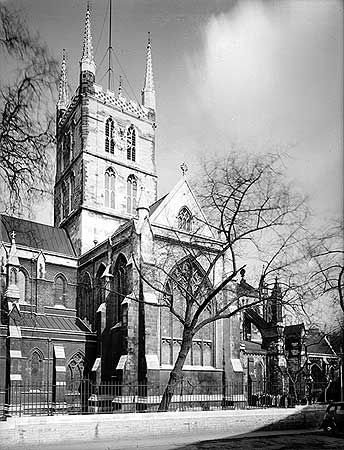
Southwark cathedral in the 1950s

The Church of St Saviour and St Mary Overie only became a Cathedral in 1905.  Although frequently thronged with visiting tourists, this lovely building on the South Bank is well worth visiting.

When I took this photograph, the Shard was not quite finished.

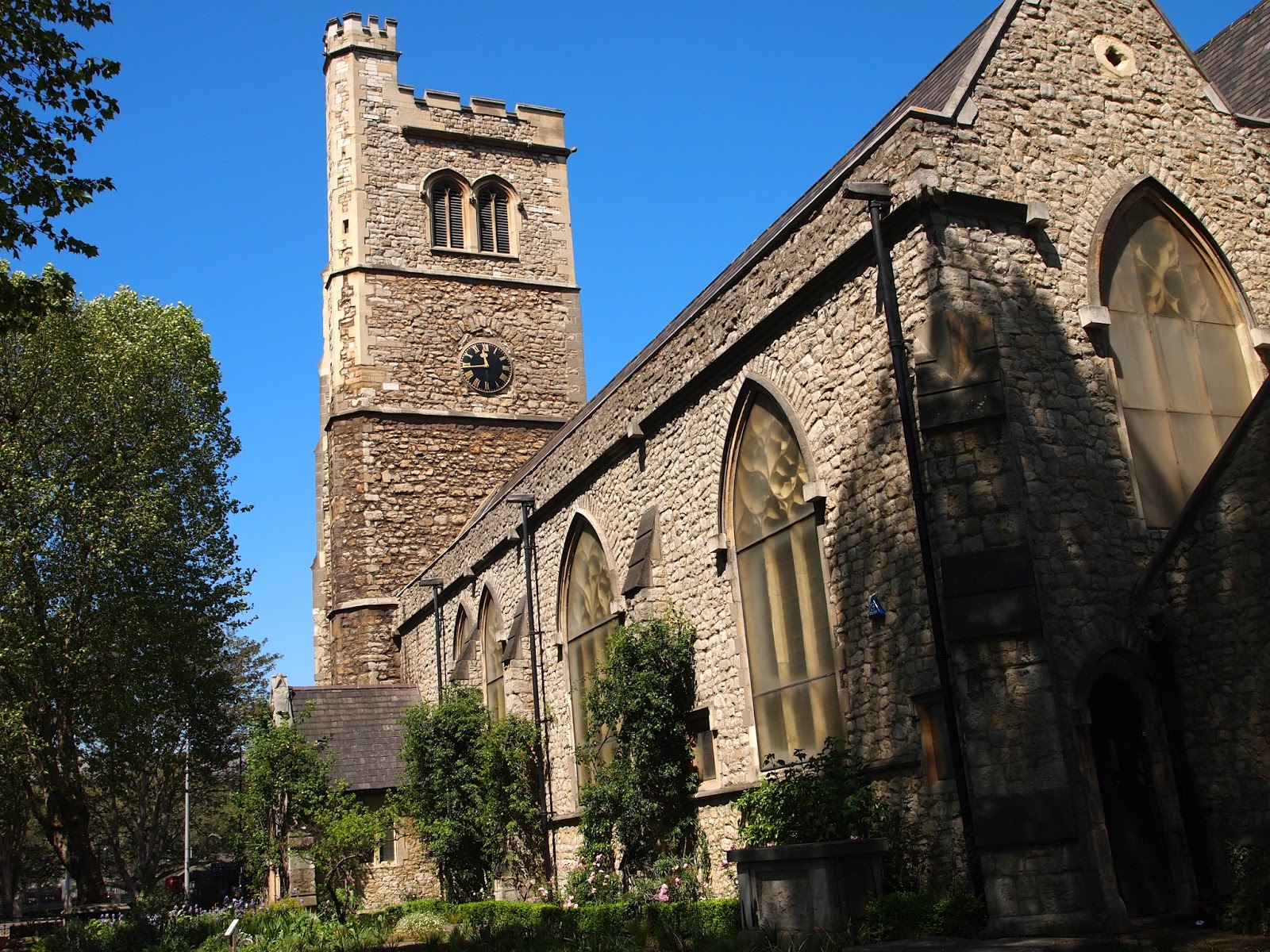
St Mary-at-Lambeth next to Lambeth Palace in the 18th century

Now the Garden Museum in Lambeth
You can read my blog about finding my ancestors in St Mary's churchyard here.

 St Katharine's Docks were built after the monastic hostel of St Katharine and 1250 houses were demolished.  Opened in 1828 they were severely damaged by bombing in 1940.  In 1968 the Docks closed but St Katharine's Marina opened in 1973.  It is a lovely spot to walk around, eat or shop.  I go to see the beautiful Thames Barges moored there.

St Katherine's Dock

St Katharine's Marina

The Thames Barge makes this picture special.

From this angle you can avoid seeing the high modern buildings.