ONE LOVELY BLOG


I've been nominated for the ONE LOVELY BLOG award by talented author and stimulating blogger Terry Tyler. You can find her post here 

Here are the rules for the One Lovely Blog Award:

• Thank the person that nominated you and link back to that blog. 
• Share seven things about yourself – see below.
• Nominate 15 bloggers you admire – also listed below.
• Contact your bloggers to let them know you've tagged them for the ONE LOVELY BLOG AWARD 
If I've nominated your blog, please don't feel under any obligation to join in.  I am just pleased to recommend your blog here.

So at the risk of boring you, here are 7 things about me:-

I have always been a book worm and after over 30 years running a junior school library I am especially fond of authors like Rosemary Sutcliff, Joan Aiken and Philip Reeve. These days I am actually moving from Young Adult books into adult books but I may revert! 

 History has always been very important to me. I taught Tudor history for many years but my particular interest is Victorian London, where my barge building and lightermen ancestors lived.


 I am a volunteer researcher for St Luke’s Hospital Heritage Project and we have established an exhibition and a bank of artefacts and digital resources in the old Casual Ward of Guildford Workhouse.  I love finding out about the lives of individual workhouse inmates, nurses in the War Hospital and what happened to the workhouse children who were sent to a new life in Canada. You can read about our project here:-

 I have been researching my family history since 1998.  While searching for ancestors in Scotland, Ireland, East Anglia, Berkshire and south London I have discovered distant cousins in the United States, Canada, Australia and South Africa, some of whom have become good friends.


The Far East is a special place for me.  I lived in Singapore for 3 years in my late teens and have revisited twice in recent years.  The changes have been dramatic but it is still a place of sunshine and flowers with a blend of customs from many cultures.  I first visited Hong Kong in 1967 and returned several times when my husband was working there.  It really is the city that never sleeps and is so exciting and vibrant.


Sunshine and the sea are a necessary part of life so my husband and I travel to the Algarve for a few days most months.  We have started Portuguese lessons and although reading with understanding is becoming much easier, speaking and understanding spoken Portuguese is much more difficult!


My guilty secret is my daily dose of Home & Away.  I would love to visit Summer Bay and meet those River Boys.

Here are my 15 blog recommendations:-

My book reviews are moving to new site.  You will find them at Lizannelloyd lost in a good book
http://lizannelloyd.wordpress.com/  You can reach it by pressing the tab above.


Eaten by Cannibals

The story of John Williams, missionary

Yesterday a photo of the ship halfpenny, used in Britain from 1937 until 1969, was posted on Twitter. As soon as I saw it I was back in my Sunday school class in the late 1950s putting my ha’pennies into the collection box for the John Williams VI missionary ship.


As you might expect John Williams VI was the sixth ship of that name, but who was John Williams?  John Williams was born in Tottenham in 1796 and he became an apprentice to an ironmonger where he worked in the foundry and as a mechanic. Originally brought up as a Baptist, he joined the Congregational Church and in 1816 knew that he wanted to be a missionary.  He was commissioned by the London Missionary Society at the circular Surrey Chapel in Blackfriars Road, Southwark.  The LMS had been set up to, “Spread the knowledge of Christ among the heathen and other unenlightened nations.”

John Williams

In 1817 John and his wife Mary set out for the Society Islands, an archipelago which includes Tahiti. They were accompanied by William Ellis, another missionary, and his wife. After a long voyage via Australia and New Zealand they arrived at the island of Raiatea where John and Mary Williams established a missionary post, from where John could visit several other Polynesian island chains.  This included the undiscovered island of Rarotonga, covered in dense jungle on a mountain of orange soil surrounded by a coral reef and a turquoise lagoon.


In 1821 John revisited Sydney where he preached and addressed public meetings.  He was influential in the later establishment of the Aboriginal Protection Society.  He bought a ship to trade between Raiatea and Sydney and employed Thomas Scott to instruct the Raiatean people in growing tobacco and sugar cane.

John and Mary had 10 children and they were the first mission family to visit Samoa.  By 1834 Mary was quite unwell so she and John returned to England.  They were accompanied by Leota from Samoa, who wished to live as a Christian in London.  When he died he was buried in Abney Park Cemetery.  John published his, “Narrative of Missionary Enterprise.” Appealing to the public, he raised £4000 to purchase a ship, the Camden, and he also supervised the printing of a New Testament in the Rarotongan language.
In 1837 John and Mary returned to the Polynesian Islands to continue their mission.  In Tahiti, John built a boat, “Messenger of Peace,” and later another, “Olive Branch.”

Sadly in 1839 when John Williams visited the island of Erromango in the New Hebrides, accompanied by fellow missionary James Harris, they were clubbed to death and eaten by cannibals.  In December 2009 descendants of John Williams travelled to Erromango to accept the apologies of descendants of the cannibals at a ceremony of reconciliation.

John Williams VI

The London Missionary Society were able to purchase a new ship to continue John’s work using money raised by “Juvenile Friends,” a fund collected by children in the Congregational Church.  The ship “John William” was launched in 1844 and set sail from Gravesend with new missionaries.  Over the years there were seven John Williams ships, the last “John Williams VII” being decommissioned in the 1970s.

To read more about John Williams please go to:-

Merry-Go-Rounds and Velocipedes


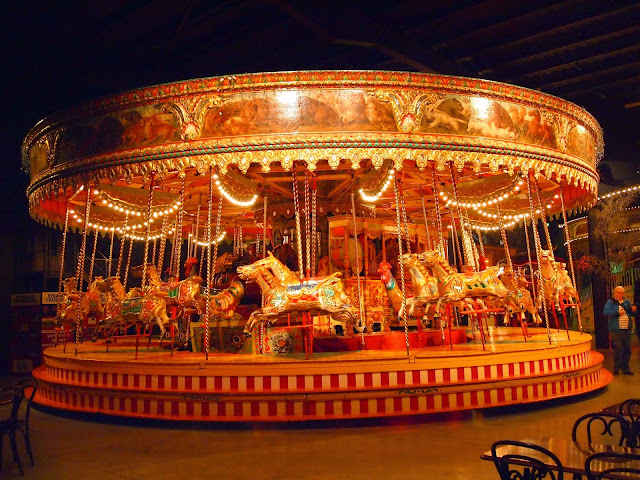
I have always been fascinated by fairground horses ever since I inherited my grandfather's rocking horse which was made by Savage's in King's Lynn, who usually only made fairground horses.

Savage Carousel at the Thursford Collection in Norfolk
Frederick Savage, a renowned manufacturer of Carousels and Agricultural Machinery in the second half of the 19th Century might have made his equipment in Australia rather than in England, if only his mother had agreed to join her husband in Tasmania.

His father William Savage was a hand-loom weaver in Hevingham, Norfolk, who owned a small farm and six cottages, but with the introduction of power looms and decline in demand after the end of the Napoleonic War, William was forced to sell his property and take to poaching for survival.  As a result of the threats he made to a local gamekeeper one night, he was sentenced to 14 years penal servitude.  Young Frederick was only 18 months old and had a new born brother, when his father was transported to Tasmania in December 1829.

After 7 years William Savage was released and he asked his wife Susan to join him but she declined and remained in Norfolk.  Within a year she had given birth to a son, followed by two more children within the next 6 years, all out of wedlock.  William lived his remaining years alone in Australia.

Despite growing up in poverty, Frederick Savage worked hard for several employers in Norwich and King's Lynn, learning how to make agricultural implements, to work iron and as a wheelwright.  This basis in engineering enabled him, at the age of 25, to obtain premises to set up a forge. Starting with forks, he moved on to producing threshing machines.  In the 1870s he purchased several acres of land in Kings Lynn to build St Nicholas’ Ironworks.  There he produced a patent cultivating system, powered by a 10 horse traction engine.


In the early 1880s Savage turned to fairground rides.  These included a circular velocipede of 24 linked bicycles, “Sea on Land” and the “Galloping Horses” which are familiar to any Merry-Go-Round rider.  It was his use of steam power which made more sophisticated fairground rides, such as the Razzle-Dazzle and Steam Yachts, possible.
Statue of Frederick Savage in Kings Lynn
In 1883 Frederick Savage became a local councillor and he held his seat in Lynn for 10 years before being elected an alderman.  He was chosen as Mayor in 1889 and as a consequence of his prodigious fund raising for the local hospital, a statue of Frederick was erected in the town.

For more information and photographs of Savage's fairground rides
https://www.sheffield.ac.uk/nfca/researchandarticles/fairgroundridesindex

Sources
Glimpses of Fiddaman's Lynn by Rosemary & Stan Rodliffe
"Frederick Savage, I presume" by Brian Morgan in "Merry-G-Roundup" Summer 2014 official publication of the National Carousel Association 

Caleb Lovejoy


I can never resist an unusual name and this interesting character, still has a commemoration service held every year, over 400 years since he was born.  Caleb Lovejoy was baptised at St Nicholas’ Church in Guildford on May 8th 1603, the son of Phillip Lovejoy.  He was an intelligent boy who was given a free education at the Royal Grammar School before being moved to Southwark by his parents at the age of 14.


In London, Caleb was very successful.  He was a member of the Merchant Taylors’ Company, one of the Great Twelve Livery Companies, which gave him the freedom of the City of London.  He owned the Walnut Tree Inn and other property in Southwark and became a wealthy merchant who supplied wagons to Oliver Cromwell’s army, during the Civil War  His support for the Parliamentary cause was further demonstrated when he ejected the King’s tenants in Walnut Tree Alley.

But Caleb Lovejoy is primarily remembered in Guildford, as a benefactor.  In his will of 1676 he bequeathed property under lease in Southwark to form a charity for the benefit of the poor in Guildford.  He appointed three Guardians as Trustees.  Six pounds per annum was to be provided for, “teaching of poor people’s children their letters until they could read their Testament.”  The teaching to be undertaken, “by some honest poor woman.”  After 45 years four almshouses should be built in the parish of St Nicholas as accommodation for four poor persons of good character.


However it was not until 1839, after the sale of Caleb’s estate, that land was purchased in Bury Street Guildford to build the four almshouses.  The eligible old people were required either to have been born in the parish or have lived there for 50 years.  They were given an allowance and must wear the uniform of a blue home-made gown with a badge of red cloth bearing the letters CL.  The houses were built as a low terrace of sandstone blocks with grey/brown brick dressing.  Attractive wavy-edged bargeboards were put along the bottom of the roof.


Also in his last will and testament, Caleb directed that he should be buried in St Nicholas’ churchyard and that the priest should be paid for a yearly sermon in commemoration of Mr Lovejoy.  There are two brass plates in the church; one giving details of Caleb Lovejoy’s legacy and his death and burial in February 1676 at the age of 74; the other bears the following verse which is said to have been composed by Caleb:

Caleb Lovejoy, here I lye, yet not I,
My body being dead
My soul is fled unto Eternitye
There to injoye that everlasting Bliss
Which Jesus Christ, my Lord
Who’s gon before, prepared hath for his;-
Wherefore my Body rest in hope till then
When he shall joyne thee to thy soul agen
And bring thee unto that most glorious vision
There to enjoye thy God in full Fruition.


 Sources 
N. Chadwick via www.geograph.org.uk
www.heritage-explorer.co.uk
St Luke's Parish magazine
British History online
www.exploringsurreyspast.org.uk
"Rambles Around Guildford" by W C Smith

Florence Desmond


The name “Florence Desmond” may be familiar to those who have attended the Florence Desmond Day Unit at the Royal Surrey County Hospital in Guildford but not so many people will remember her for her acting talent during the first half of the twentieth century.

Born in London in 1905, Florence Desmond was performing on stage as a dancer from the age of 10.  She later became known as a singer and comic actress and as an excellent impersonator of famous actresses such as Bette Davis, Marlene Dietrich and Greta Garbo.  In her obituary in the Independent in January 1993 she was described as, "Not only the best impersonator of her generation, but by far the best."  She demonstrated a satirical talent without any cruelty to the people she mimicked.

In 1928 Florence performed in, "The Year of Grace," a revue written by Noel Coward and she accompanied the production to New York where she danced with him.  She was to take New York by storm 18 years later at the "Blue Angel" nightclub with her witty and accurate impressions of Hollywood stars using minimal props.  Miss Desmond participated in the Royal Variety performances in 1937 and 1951 and she was the leading lady in two films starring George Formby.  Mr. Formby called her, "an inimitable comedienne."  Florence also acted with Gracie Fields and frequently starred in pantomime as a principal boy.


In 1935 Florence married Tom Campbell Black, an aviator, but she was heartbroken a year later when her husband died at Speke Airport in Liverpool after his plane struck an RAF plane on the ground.  Her second husband, Charles Hughesdon, was also an aviator and in 1937 they set up home together at Dunsborough Park in Ripley.  During the Second World War, Florence toured army camps with ENSA entertaining the troops.  Her peaceful post war life was upset by a daring robbery. Luckily Florence and her husband were away from home and the household staff disturbed the burglars, but not before they had stolen a mink coat and stole. 

In 1963, Florence Desmond began fundraising for the purchase of a Betatron electron therapy unit to be installed at St Luke’s Hospital in Guildford.  She stated that, “If Betatron had been available, cancer might not have killed my beloved father.”  The Betatron, made in Switzerland, the first of its type in the UK, was used to treat primary malignant cancer.  £200,000 was required, of which Miss Desmond personally contributed £9,000 .  The climax of the fundraising was a Royal Gala on the stage of the Odeon in Guildford attended by Princess Alexandra and her husband Sir Angus Ogilvie, with performances by Vera Lynn and Max Bygraves.

The Betatron was installed in 1967 and remained in service at St Luke’s Hospital for 24 years.  A ward at St Luke's was named Desmond Ward in recognition of her considerable achievement. In 1991 when the McMillan Day Hospital was transferred to the Royal Surrey County Hospital it was decided to use her name again for the new Florence Desmond Day Hospital and on October 16th that year Florence visited so that she could see the excellent new facilities.

Florence Desmond spent her retirement at Dunsborough Park, enjoying the attractive gardens and the farm where she was once pictured in the Evening Telegraph with her sow and 10 piglets.  She died in Guildford on January 16th 1993 at the age of 87.

Florence Desmond performing with George Formby.

The little book belonging to Bartholomew Glasscock


One of the most exciting finds connected to my family history was a tiny book wrapped in brown paper.  It was hidden in a bookcase which I was going through after my mother died.


When first researching my grandmother’s ancestry I had hit a brick wall with her grandmother Elizabeth Palmer.  In 1842 Elizabeth Palmer married William Hopkins, part of a well-established family of Thames Lightermen in Lambeth and Southwark, but Elizabeth came from the small village of Sheering in Essex and I had problems discovering more about her family.

Gradually over many years I traced her father Thomas Palmer son of George Palmer and Mary Glascock also from Sheering and I was intrigued by Mary’s father Bartholomew Glasscock who although also born and married in Sheering appeared as a witness to many marriages at St Mary’s church in the nearby village of Matching.


Opening the little brown book revealed that all my research had been correct.  There were four handwritten names, three of which followed the family tree I had researched. The second name was Bartholomew Glasscock my 5th great grandfather, the third name was Elizabeth Palmer, my 3rd great grandmother and the last name Constance Talbot was my grandmother.

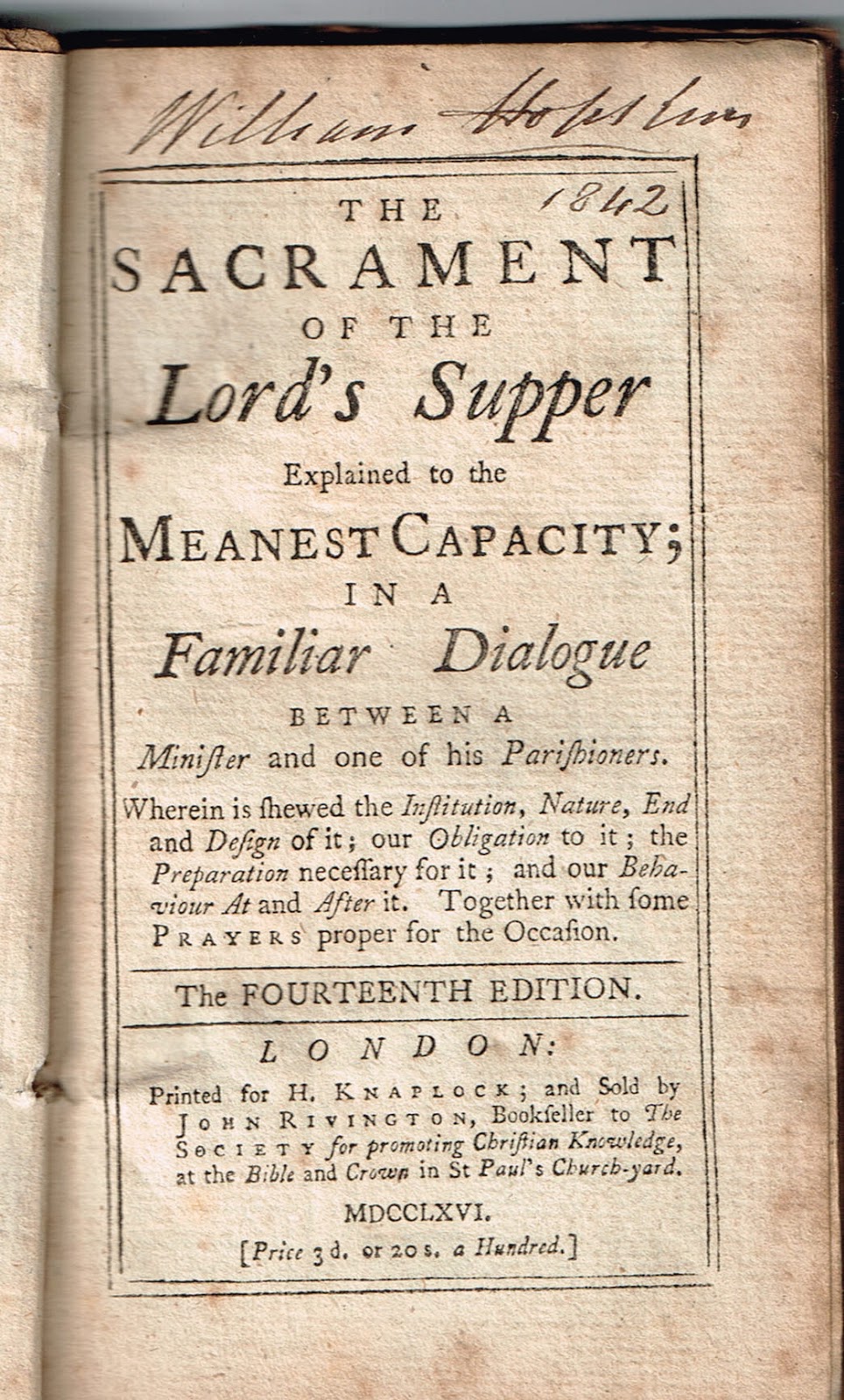
So what is this little book?  It is “The Sacrament of the Lord’s Supper explained to the Meanest Capacity in a Familiar Dialogue between a Minister and one of his Parishioners” printed in 1766.  On the next page was written William Hopkins, husband of Elizabeth Palmer and the Granddad who had passed the book on to Constance Talbot.


I was able to discover William Dearing by Googling.  He was Vicar of St Mary the Virgin in the village of Matching in Essex from 1761 until 1785.  This was the time when Bartholomew Glasscock was witnessing marriage ceremonies in that church.


St Mary the Virgin, Matching, Essex

I have now visited the charming church in Matching down a narrow country lane and continue to explore the Glasscock family in Essex. I do like it when all the pieces of a jigsaw fit together especially with a primary source!

In December 2015 I was contacted by a Glascocke descendent in Virginia.  We are now investigating the unlikely possibility that our shared ancestor was one of the first 17th century residents of Jamestown, Virginia.