Showing posts with label Guildford. Show all posts

Helen Lloyd energetic WVS volunteer #WW2 #evacuees #MondayBlogs


In 1938 when the Woman’s Voluntary Services were established, Helen Lloyd, a 39 year old resident of Albury, Surrey, where she lived with her parents, volunteered to take charge of the reception of evacuees in the Guildford Rural District.  We are able to discover a great deal about her ever widening responsibilities for the WVS through the diaries she wrote for the Mass Observation Archive.

From 1939 till 1940, 1100 evacuees arrived in the Guildford Rural District, many in 1940 having been moved from the south coast where they had first been housed.  Apart from the logistics of finding homes for the children, Helen commented in her Narrative Reports to the WVS headquarters that Enuresis (bed-wetting) was a severe problem for families taking care of the children.  Many solutions were suggested throughout the country, such as not allowing children to pick dandelions, but Helen believed, “All that is needed is a legion of old-fashioned nannies who love the children dearly but who stand no nonsense from their charges.”  She may have followed this herself for she remarked in her diary that she had happily replaced a bath and a drink before dinner with a session reading a story to the four boys residing with her family.

The WVS centre for Guildford Borough was organised by Mrs Eileen Leach, but Helen’s base was also in Guildford and she had regular meetings with Mrs Leach. Though not specifically connected with Warren Road Hospital, Helen often went there in her role as WVS district organiser.  Her diary entry for

June 15th 1940

“Took a car full of teapots and cruets to Warren Road Hospital.  Mrs Thomas objected to appeals being made for the hospital as it made public the fact that it was badly equipped – which of course was the case.”

October 26th 1940

“To Warren Road Hospital to give blood.  Had to wait 40 minutes but enlivened the time by gossiping with Mrs Cooper who was taking records.  The operation was extremely simple and I felt ashamed of having a fluttering head.  The doctor was charming and I admired and wished to emulate his bedside manner.”

Helen was concerned that the London boroughs made no attempt to forward the children’s medical records or spectacle prescriptions, but the main medical concerns were obvious.

December 30th 1940

“Had to take two of Mrs Strachey’s children to Warren Road Hospital with impetigo and nits!”

January 31st 1941

“Eight cases of scabies and nowhere to put them; 3 measles contacts and no billets; an expectant mother imminently expecting; a child admitted to Warren Road for impetigo has measles there and no-one is told; a second child of Mrs Strachey’s has scarlet fever though the school doctor pronounced it to be nothing.”

The highlight of June 1940 was the arrival at Guildford station of men evacuated from Dunkirk.  Mrs Leach was in Helen’s office organising food for the trains when there was a message for them to go to the station as soon as possible.  There they found chaos as train after train of hungry and thirsty English, French and Belgian soldiers stopped en route from the south coast.  “The waiting rooms on the platform were transformed into larders and pantries and were filled with people cutting sandwiches.  Churns of hot tea ladled into tins, jam jars, anything that would serve as a cup.”  For four days the WVS continued to serve the soldiers with the, “enthusiastic support of Guildford tradesmen willing to be knocked up at all hours to give goods at a discount of sixty per cent.”

After Dunkirk, the Guildford scheme was instigated, “Whereby we shall keep a list of lodgings, free or otherwise, for the wives and relations of wounded (servicemen) on the danger list.  These people are, if necessary to be met at the station and taken to the hospital or billets.”

Meanwhile the rural WVS were to supply ashtrays, handkerchiefs, drinking beakers, books and games for the injured soldiers at Warren Road Hospital.

On one occasion Helen recorded that a family had been sent from Bristol because the husband was dying of cancer at Warren Road Hospital.  His wife and six children were sent to Ockham Park which made it impossible for them to visit the hospital so she persuaded the Billeting Officer to find them a council cottage in Shackleford.

Later in 1941 Helen Lloyd reported that 3 bombs had dropped near to Warren Road Hospital killing 2 people, injuring 9 and making 200 homeless.  In October 1941 a British Restaurant was opened in Charlotteville.  This was a communal feeding centre, a cafĂ© where a full hot meal could be purchased for one shilling, served and washed up by the WVS.  At the same time WVS members were knitting scarves, helmets, socks, sweaters and gloves.  By 1941 almost 3,000 children had been evacuated to the 22 parishes in Helen’s Rural District.  In January 1942 when there was thick snow on the ground, Helen skied into Guildford from her home in Albury.

In June 1942 there were 542 WVS members in Guildford Rural District and 1,005 in the borough of Guildford.  An editorial in the Surrey Times of 29th October 1943 expressed the opinion that, “While the grey uniforms of the members of the WVS are seen mingling among the crowds in our streets, few of the public are conscious of the valuable work they undertake.”

For more interesting details:

“Warriors at Home 1940-1942” edited by Patricia and Robert Malcomson

“Women at the Ready: The remarkable story of the Women’s Voluntary Services”by Robert and Patricia Malcolmson

#PastMeetsPresent in Guildford

I recently bought a book of old 19th century pictures of Surrey views, collected and printed by Charles W Traylen, a bookseller, who lived and worked in Guildford from the 1920s until his death in 2002.  There are 24 reproductions of pictures around Surrey which include the following Guildford views.


As you can see Guildford hasn't really changed very much.

The Guildhall at night


I can't really reproduce this picture today as there is now a block of flats in the foreground so here is a photo looking from the opposite direction half way down the High Street.


And Abbot's Hospital is still providing a home for the elderly who were born in Guildford as Archbishop George Abbot wanted it to be.

Footnotes on the Artists

George Sidney Shepherd, who painted the view of Abbot's Hospital, was the son of a watchmaker who lived in London.   By 1800 he was exhibiting watercolours at the Royal Academy and he specialised in townscapes and scenes of London.  Although very successful, he spent his last years in poverty and died in a workhouse.

Charles Claud Pyne was a watercolour artist and Art Master at the Royal Grammar School in Guildford.

#PastMeetsPresent is inspired by Becky B.  Here is her July post from Portugal https://delightsofthealgarve.com/2017/07/01/algarve-salt-production/

The rise and fall of Joshua Crompton #18thCentury

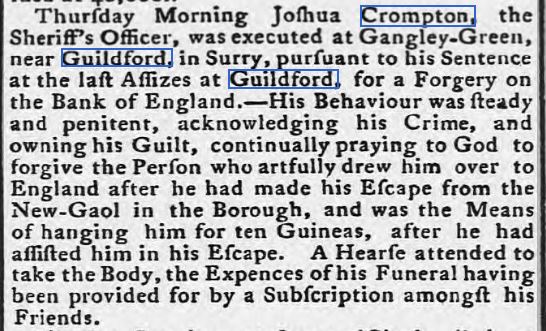
In a 1950s housing estate on the outskirts of Guildford, there is a tiny trace of the old woodland, once called Gangley Common, where executions took place.  One of those hangings in 1778 was of a man called Joshua Crompton for the crime of forgery.


At a time when there were a considerable number of counterfeit notes being circulated, there is no doubt that Joshua was being used as an example to others, but he was also a victim of extremely bad luck and treachery after a see-saw life of prosperity and penury.

Joshua Crompton was the last born child of a family of 15 in Bolton, Lancashire.  After being orphaned at the age of 10, he travelled to Manchester where he found work with a gentleman’s family, eventually becoming their coachman.  Also in the household was the master’s wife’s sister, who in Joshua’s own words, “had conceived a partiality and tenderness to me.”  He encouraged this, resulting in their marriage, which brought him a small fortune.  Returning to Bolton, Crompton opened up an ironmonger’s shop but this failed so he moved to Liverpool where he became a Sheriff’s Officer, a respectable position.
 
Red Lion Square, London
But Crompton, unwisely, became infatuated with a young woman and they moved to London together to open up a shop in Red Lion Square.  Having persuaded his mistress to return to Liverpool and giving up the shop, he was sworn in as an officer to his Majesty’s Palace Court, where he dealt with debtors, but ironically by 1775 he had to quit this position because he was in debt himself to the tune of £1500.   He was also concerned about the delicate state of his wife, who was, “lying in.”

Despite his insolvency he managed to purchase the position of Sergeant of mace, when his actions brought him into more trouble.  Meeting with friends in May 1777, he planned visits to the races at Newmarket, Epsom and Guildford Down.  According to Joshua, his successful winnings at Epsom Downs were put in his pocket book and two days later he needed to buy some new boots.  While in Mr Gaskin’s shop, he was tempted to buy a new gown for his wife.  In fact, he decided on four gowns, giving a twenty pound note for the payment of four pounds, thirteen shillings.  Mr Gaskin needed to change the large note at the neighbouring Spread Eagle and after receiving the balance, Crompton returned to London.

On May 20th Crompton set out for Guildford with his friend Richard Wiltshire but the inclement weather tempted them into a Taproom at Ewell.  There Mr Peckering, the landlord, spoke of the dire experience of his acquaintance Mr Gaskin, in Epsom, who had recently been passed a counterfeit £20 note.  The two men continued to Guildford where they arranged a room at the White Horse before drinking in the Red Lion.  Hearing next morning of the arrival of the Bow Street Runners in the town, Joshua ordered his horse and returned to London where he told his tale to the landlord of the City of Bristol in Wapping.  He managed to board a vessel for Scotland, arriving in Dundee on May 31st.  But two days later, he was arrested there by the Runners who had travelled non-stop in response to a tip-off.
 
Sir John Fielding
In London, Crompton was examined by Sir John Fielding and confined in the new prison at Clerkenwell, before being moved to Newgate prison.  He had given testimony against three other men who had assisted him, including a leading Tea-dealer near Tower Hill and his friend Richard Wiltshire, who was apprehended.  Prior to his trial in Surrey, where the offence took place, Crompton was moved to the new gaol, Southwark.


At this point, his friend, Francis Crooke suggested the possibility of escape.  Dressed in woman’s clothing he walked boldly out of the gaol and later he crossed the sea to Flushing in Holland.  There he picked up his life and was doing well in the smuggling business, but Crooke suggested he return to England, saying that he had obtained a pardon for Joshua.  In reality, the aptly named Crooke had negotiated a two hundred pound reward from the bank and one hundred from the gaol Keeper.


On July 29th 1778, Joshua was taken to Guildford for the trial.  Several witnesses gave convincing accounts that he had knowingly presented the note but there was no evidence that he was responsible for the forgery. Crompton was declared guilty and was condemned to death.  Showing penitence and forgiveness, Joshua Crompton was hanged at Gangly Green, Guildford on August 24th 1778.

On a Cold Winter's Night #Barnardoboy #Canada

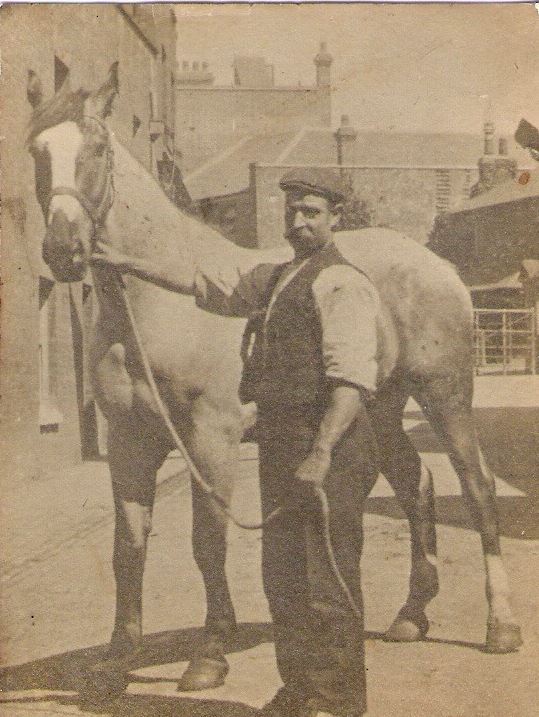
On a cold winter’s evening at the end of December 1903 Emma Fricker took a cup of coffee to her husband, Eli, while he was working in the stable which was next to their home in Friary Street, Guildford.  He was a carman, working for Mr Charles Holden, grocer.  It was necessary for groceries to be delivered regularly, by horse and cart, to the larger homes on the outskirts of town.  At 9.20pm Emma heard a noise from the stable and when she went to investigate, she found her husband unconscious, lying on his back close to the hooves of one of the horses.  Two of her neighbours carried Eli, who was bleeding from a head wound, into the house but although he groaned he did not regain consciousness.  By the time he was seen by a doctor he had died aged only 41.


Visiting Friary Street today, you will see only shops and restaurants and most of the original buildings have been destroyed, but at one end there is a trace of the houses dating from before the time when Eli and Emma lived there with their 9 children.  Another employee of Mr Holden, Thomas Lee, told the borough Coroner that he had shared a beer with Eli Fricker at 8.50 that evening in a nearby beer house and that he had warned him about one of the horses, which was prone to kick, when he returned to the stable.  All agreed that Eli seemed strong and healthy and his skull had not been fractured but his heart was in a bad condition and he was said to have died of syncope.


Mr Holden was generous to the grieving widow as Eli had been an exemplary employee and a concert was organised in the Constitutional Hall to raise funds for the Fricker family.  Despite this generosity it must have been very difficult for Emma to support her children.  Eli’s last child, Agnes Rose Fricker was born in February 1904, 6 weeks after her father’s death.  By 1906 Emma had moved to the Shambles off the High Street. Her 9-year-old son Charles Henry Fricker had been sent to Dr Barnardo’s and in 1905 he had sailed on the SS Dominion with a group of British Home Children to live in Ontario, Canada.  Her younger son William John can be found in 1911 as one of 1073 boys at the Royal Navy Training Establishment in HMS Ganges, Shotley, Suffolk.  Meanwhile most of her daughters went into domestic service.


But this was by no means the end of their stories.  Emma remarried in 1906, becoming Mrs Strange.  Charles Fricker married Pearl Teskey in 1914 and they had ten children.  He died in North Bay, Ontario in 1973.  He had been joined in Canada by his brothers Albert and William and also by his mother Emma and all three also died in Ontario.  William John Fricker had a particularly successful life.  He moved on from training school to the navy throughout World War One and was promoted to officer status in 1918.  After visiting Canada in 1923, he returned to Guildford to marry Amy Ann Lefevre in his smart naval uniform.  Lieutenant Commander William Fricker received the King’s Silver Jubilee medal in 1935 and served with the Canadian navy during World War Two.

Postscript
I have received further information from a descendent of William John Fricker. He met Amy Lefevre in North Bay, Ontario when visiting his brother Charles in Canada.  After he returned to Guildford, Amy followed some months later. The couple returned to Canada just before World War Two.


You can read more about British Home Children in my earlier blog

A nineteenth century #Romeo and Juliet?

Guildford

On Tuesday November 3rd 1863 there was a feeling of rising tension among the residents of Guildford in Surrey.  Some were looking forward to the excitement of the bonfires and celebrations they had become accustomed to on November 5th but many prominent citizens, including the Mayor, were worried about the damage and destruction they expected from the “Guildford Guys,” a group of increasingly defiant revellers.


Almost un-noticed, a young couple booked into a room above the Coachmakers’ Arms in North Street.  The young man, Joseph Mahaig (Maharg), was tall, with dark hair and hazel eyes and was a sergeant in the 3rd Buffs.  His “wife” was in fact an unmarried servant called Elizabeth Waterer.  Elizabeth was described as a fairly tall, good looking girl of about 28.  Joseph Mahaig had served in China during the Opium War and was shortly to embark to India.


At this time marriage was not a straightforward option for a young soldier in the British army.  As the army increased in professionalism, women found themselves excluded.  Although officers were encouraged to marry, other ranks were positively discouraged. Only a proportion of one in twelve men were granted permission by their commanding officer to marry and fewer still were allowed to bring their wives to accompany them overseas.  There the wives and children shared the barracks with the other men using blankets hung over rope lines for some privacy.


Joseph and Elizabeth stayed on the second floor of the Coachmakers’ Arms and were stated to be, “remarkably quiet and civil.”  They had breakfast and tea on Wednesday, but had no food on Thursday November 5th, although Joseph told Mrs Hedges, the Beerhouse Keeper’s wife that they were expecting Elizabeth’s mother to join them.  By Friday afternoon there was a sense of unease among the other residents of the Coachmakers’ Arms since nothing had been seen or heard of the couple for over 30 hours.  When there was no response to knocks on the door, a sergeant of the 37th regiment, who was billeted there, suggested breaking it open but Mrs Hedges decided to send for the police instead.


Superintendent Vickers arrived, accompanied by Sergeant Steads and P C Davis who made up the full strength of the police force in Guildford at that time.  When they forced open the door, it appeared that the young couple were lying dead on the bed.  The woman looked as if she had been strangled and the man had a large gash on his throat.


Mr F D Ross, a local surgeon, was quickly summoned, together with Dr. Chapman of the 37th Foot.  The gash on the soldier’s larynx was carefully stitched and, “A small quantity of brandy was given to the man, upon which he slightly rallied.”  The two doctors believed that the young woman, whose head was hidden under a pillow, had been dead for at least 2 days. 


A post mortem examination was conducted by Mr Phillips MRCS and his colleague Dr Sells.  Their problem was that the head and neck were in an advanced state of decomposition.  The question was, had Elizabeth been smothered or strangled or had she taken poison.  Elizabeth had been witnessed purchasing a threepenny packet of Butler’s Vermin powder, which contained two grains of strychnine, from a local chemist on the day she died.  No doubt she had read of the young lady in Shoreham, who earlier that year had poisoned herself with that powder when denied the right to marry her desired suitor by her father.


At the Coroner’s inquest, Mr Phillips stated that a partial analysis of the contents of her stomach suggested poison had been taken but that he was of the opinion that the immediate cause of death was suffocation caused by strangulation.  Mr Sells added that there were marks around the neck and under the skin suggesting strangulation.  However the state of the heart was not consistent with strangulation.  He could not positively say that death had been caused by poison.


In the room where the young couple were found were several relevant letters, two written by Elizabeth and three by Joseph.   In one of Mahaig’s letters he stated that having left the room, he returned to find Elizabeth with a rope around her neck. He took it off and then that they both took poison. 


Because of the doubt over cause of death, the inquest was adjourned and at the insistence of the Home Secretary, further analysis of the contents of the stomach was made by Professor Taylor of Guy’s Hospital.  Professor Taylor concluded that there was clear proof that Elizabeth had died from poisoning.


Dr Phillips had feared that Joseph would not recover from his neck wound since it was severely inflamed so he was taken, on November 6th to Guildford Union Workhouse where he was kept under police guard, to prevent further suicide attempts, until the inquest was resumed at the end of November.  While in the Workhouse he wrote a statement about the events which had occurred at the Coachmaker’s Arms, since he was unable to speak.  Although the jury found that Elizabeth Waterer destroyed her own life, they found Joseph Mahaig guilty of aiding and abetting her in this.  He was therefore bound over to appear at the next Surrey Assizes in Kingston-upon-Thames on the charge of, “Wilful Murder.”


At the trial in December Joseph was found guilty but the jury strongly recommended mercy.  Despite this appeal the Judge passed sentence of death on Mahaig who stood upright and heard his sentence without flinching.  He was taken to Horsemonger Lane Gaol where he was due to be executed on January 12th.  A number of the residents of Guildford, many of them Quakers, appealed to the Home Secretary that mercy should be applied.  According to the Sussex Advertiser of January 2nd 1864, “Several philanthropic ladies are desirous of exercising their good offices by visiting the condemned cell, but their entreaties had been refused.”


At the last moment, Mahaig’s sentence was Respited during her Majesty’s pleasure and on January 24th it was commuted to penal servitude for life.  More than a year later Joseph was transported on board the convict ship Racehorse to Western Australia.  On 22nd of October 1865 he was drowned while apparently attempting to abscond in Champion Bay and he was buried in Old Geraldton Cemetery north of Perth, Western Australia. 

Elizabeth Waterer had been laid to rest in St Mary’s churchyard in Guildford on November 9th 1863.


A letter, written by Joseph Mahaig, while he was recovering in Guildford Union Workhouse.  The letter was handed to a police constable to be given to the Coroner.   Joseph was unable to speak owing to his neck wound. 


26th November 1863

I do not know what to write what you may ask for shall I put this day the 26th of the month?-where am I going after that?  I may let you know that we both partook of the poison at the same time, but the poison that I took, that she gave me, she bought at another shop.  It had a blue cover and half an hour afterwards she was dead.  I think it was the night of the 3rd.  We both said, as she would not leave me, we would die together.  She died in my arms.  On the Tuesday evening she had a rope cord round her neck when I came upstairs.  At night we both took the poison in some gin about 5.30.  We both sent, at least left, a letter to both our mothers on the table.  I don’t wish anyone to see this.  Dear friend, I don’t care.  I wish to God I had went with her.

Joseph Mahaig

Birmingham Journal Dec 26th 1863


Sources


Sheldrake’s Aldershot and Sandhurst Military Gazette  14/11/1863 & 12/12/1863

Sussex Advertiser  2/1/1864

Maidstone Telegraph  5/12/1863

Sheffield Telegraph  2/1/1864

Birmingham Journal  26/12/1864

The Era  24/1/1864   (All from www.findmypast.co.uk )

Criminal Registers from www.ancestry.co.uk


Letters written by Elizabeth Waterer and Joseph Mahaig (Maharg)

Catastrophic Fire at Clandon Park #NT

The Surrey Infantry Museum

Today I share with many people great sadness at the terrible destruction of Clandon Park House by the fire yesterday evening.  Although not the most beautiful house to look at from the outside, it contained a stunning collection of beautiful artefacts, ceilings and its unforgettable marble hall. There are many pictures online of its lovely rooms including some on my Pinterest page here

The Corps of Drums of the 1st Battalion of the Queen's Regiment at Clandon Park in 1989
Last year I visited an exhibition about the First World War Hospital which was set up in the house in 1915 and while there I also spent considerable time in the Surrey Infantry Museum in the undercroft.  This contained the collections of the Queen’s Royal Regiment and the East Surrey Regiment from three and a half centuries of service.  There were uniforms, medals, musical instruments, flags and pictures from the Indian mutiny, Crimean War, Boer War and both world wars of the twentieth century.


Here are some of them.

These life sized figures dating from 1715 wear the uniform of the Princess of Wales Regiment and were made when the Regiment was quartered in Carlisle.  They carry flintlock musket, sword and socket bayonet. The leather pouch contained three grenades. 


Just some of the many medals on display including several Victoria Crosses.


The Sovereign's Colour was presented to the Regiment at Gosport in 1847.  The last time it was paraded was in Singapore in 1947,


Update about the Colours

All photos from http://www.queensroyalsurreys.org.uk/new_museum/new_museum.shtml

A year ago soldiers recreated the scene when Clandon was a War Hospital.

A sad story 

Scattered Homes

A house in Recreation Road

Towards the end of the 19th century, Poor Law Guardians were increasingly concerned about the upbringing of children in their care.  The workhouse was a totally unsuitable environment so other solutions were sought.

Boarding out in the homes of foster families was tried but there were few families able or prepared to do this.  In some areas Cottage homes were set up; several houses round a green, each housing approximately 12 children with a foster mother.  This was deemed to isolate the children in an unreal situation.

In Sheffield, J. Wycliffe Wilson, chairman of the Board of Guardians, suggested another solution.  In 1893 he set out to purchase several artisans homes scattered about the city, where approximately 15 children would live with a foster mother and attend the nearest Board School.  No more than 30 children would attend each school so that they could become integrated into the local community.  On Sundays the children would be taken to the neighbouring churches and Sunday-schools.

The success of this scheme lead other unions to adopt it and thus in 1908 Guildford Board of Guardians set up seven of these homes with romantic names such as Elsinore, Restormel and River View.  Each home housed 11-13 children aged 5-14, either all boys or all girls with a foster mother, who was usually a single woman in her 30s.  Brothers and sisters were separated into different homes.  Next door to the Workhouse in Union Road, was a Receiving Home for children where they could be assessed, but some children remained there.

The members of one family were “scattered” in several homes by 1911.  They were the sons and daughters of Samuel Norsworthy.  Samuel had been a contractor’s carman living in Quarry Street, Guildford with his wife Annie and 7 children, until Annie died in childbirth in 1910.  We find Samuel residing in Guildford Union Workhouse in the 1911 census along with his 10 month old daughter Constance, while two of his children, 11 year old Annie and 4 year old Ernest William are next door in the Children’s Receiving Home.  Meanwhile 13 year old Leonard and 6 year old Henry Charles Norsworthy are down in the town at Elsinore Scattered Home in Springfield Road.  Nine year old Cecil Norsworthy was in another scattered home, Newark in Recreation Road.  The oldest two children are at work; Selina as a housemaid in Weybridge and Samuel Arthur working as a gardener on a fruit farm in Shalford.

Another family who were split up after the death of their father were the Longhurst children from Shere.  Dorothea, aged 11, and her 10 year old brother Nicholas Irwin were lucky enough to stay with their mother, Elizabeth, taken in by their grandmother in the same village but younger brothers Edward, aged 8, and Charles, aged 6, were in the scattered home, Elsinore, while 10 year old Henry Algernon was living at Newark in Recreation Road.

Tower Hill Memorial

Henry Algernon Leslie Longhurst, can be found on a memorial at Tower Hill, recording that he was a steward in the merchant navy who was killed on SS Ashcrest on December 9th 1940, son of Elizabeth Longhurst and husband of Annie Maud Longhurst of Grange Town, Cardiff.

Priscilla Cinderalla in the Workhouse for over 10 years

In 1901 among the many inmates of Guildford Union Workhouse were the Standing family, Priscilla, aged 39 and  her three sons, Harry, aged 5, Thomas, 4 and Edwin, 2. 
Priscilla Standing

Priscilla Cinderalla Cooper was born in Lurgashall, Sussex, the daughter of a travelling farm labourer.  The 1881 census tells us that she was deaf, although this is not mentioned when she was at the Workhouse.  At the age of 22, she was working as a servant, probably a housemaid, for the Standing family. Thirty eight year old, James Standing and his wife Emma were living in Copse Green, Northchapel, Sussex with their four children.  James was Under Bailey for the Petworth Estate.  But three years later, his wife Emma died and in 1895 Priscilla married James Standing in Petworth.  James moved on to greater responsibility as the Bailiff of a farm in Surrey.  By 1899 their third child, Edwin, had been born but James died in the same year.
 
As a deaf widow with three very young children, Priscilla was probably no longer able to stay in the tied cottage provided by her husband’s work and inevitably ended up in a workhouse.  Perhaps she had walked to Guildford to look for housekeeping work. Although the 3 brothers had each other, they were taken from their mother at a very young age and she must have missed them terribly. Priscilla’s stepson, William Standing, was 21 in 1901 when she and her young sons entered the workhouse, so he was able to earn a living as a carman lodging in Angel Gate, Guildford.  Her other stepchildren were also old enough to make their own way in the world.

Priscilla was still living at Guildford Union Workhouse ten years later when the 1911 census was compiled, but her sons had all moved to other accommodation.  Edwin, aged 12, now lived at the Scattered Home for Boys at 37 Recreation Road, Guildford, with eleven other boys 5-13 years old and a foster mother appointed by the Guildford Board of Guardians.  Thomas, now 14, was still in Warren Road, near to the Workhouse, but in the Children’s Receiving Home where John William Sowers, the Superintendent, was aided by a Matron and two foster mothers in looking after 12 children aged 3 to 15. 

Henry (Harry) Standing was now 16, so he had been sent to the Training Ship, Exmouth, at Grays in Essex.  He later married Gertrude Brown and they had eleven grandchildren before he died in Liverpool in 1972.  Thomas served in the Army Service Corps in the First World War and in 1923 he married Agnes Smallbone in Hambledon.  He died in south west Surrey in 1952.
The Sunset Home in Merrow House

Despite their earlier separation, Priscilla and her sons kept in close contact throughout their lives until her death in Surrey in 1953.  She was described by one of her grandchildren as, “a lovely grandmother,” who was able to lip read and communicate well.  She spent her last years living happily at the Sunset Home in Merrow House.

With thanks to Dorothy Lauder for the photo of Priscilla.

British Home Children

In April I wrote about the first children sent to Canada by the Board of Guardians of Guildford Union Workhouse

Since then I have been researching another small group of emigrants sent from Guildford to Canada.

On June 18th 1887 a group of 115 children arrived in Quebec aboard the SS Lake Ontario bound for the Guthrie Receiving Home in London, Ontario.  They had been sent from the Children’s Emigration Home in Birmingham by John T Middlemore, boarding the ship in Liverpool, but the children had originally lived in several different parts of England.
Mr Middlemore's Book in Birmingham
Seven of the girls came from Guildford Union Workhouse sponsored by Miss Ada Spottiswoode, the only woman on the Guildford Board of Guardians.  The youngest child was 5 year old Ada Walker, whose brother and sister had been sent to Canada two years previously despite the fact that their Uncle Frederick Walker and Aunt Jane Mercer had shown willingness to look after them.  The other girls were two groups of sisters, Margaret Cheeter aged 12, Edith Cheeter aged 11, Louisa Cheeter aged 7 and Eliza Hebburn aged 11, Ellen Hebburn aged 12 and Rose Hebburn aged 18.

The Hebburn family had their name spelt Hebborn or Hebbourne on different documents.  In 1871 William Hebburn, Labourer, was living with his wife Emma (Becks) and his daughter Rose Alma in Woodbridge Hill, Stoke, Guildford but by 1881 Rose, her 8 year old brother George and her younger sisters Ellen and Eliza were inmates at Guildford Union Workhouse after the death of their mother in Bellefields in 1877.  George remained in England and can be found as a farm labourer in Littlefield Common, Worplesdon in 1891.

It was difficult to find the Cheeter girls in England until I realised their surname was Chewter.  Margaret Ellen, Edith Mary and Louisa were born in Pirbright, Surrey the daughters of James Chewter and his wife Sarah.  James was a farm labourer but he and his wife appear to be missing from the records after 1880.
 
St Mary the Virgin, Worplesdon
In fact all three families were originally from the neighbouring villages of Worplesdon and Pirbright just to the north of Guildford and as agricultural labouring opportunities declined they moved closer into Guildford so that the fathers could find casual labouring jobs.  They managed to eke out a living until one parent died and then it was impossible to provide for the family and look after the children.

Thanks to Jim Littlewood, a descendent, we know that Rose was contracted to a Mr A N C Black of PO Dutton, Elgin County. The contract is signed on behalf of Middlemore by H. Gibbons.  As she was 18, Rose was only committed to working under this contract for 3 years so it is perhaps not surprising that in 1890 she married James Collins in Tonawanda, New York.  By 1892 the New York census shows the couple with 1 year old daughter, Frances, living in Wheatfield, Niagara County NY.

By 1905 Rose’s life had changed dramatically.  She had 5 children, James, Rose, Frances, Lilly and Veronica but they are listed in the New York census of Inmates in Alms-houses and Poorhouses. The reason given was "father’s desertion".  They were transferred the same day as they arrived to "homes for the friendless".

Thankfully life improved for the family.  James Collins must have died, as in the 1910 census Rose is listed married to a Mr. John A. Clarkson.  Living with them are the 5 Collins children and 3 year old Edna Clarkson, daughter of Rose and her new husband.  Rose Hebburn Collins Clarkson died on 14th October 1944 at Buffalo, Erie NY.

Meanwhile, 12 year old Ellen Hebburn had been assigned to John H Elliott of Wilton Grove at Concession 6 of Westminster on 28th June 1887 and later moved to E Adams of Chatham Kent Co. on 22nd August 1888.  In an incident report dated February 3rd 1892 it is stated, “Ellen writes to say she has left Mrs Ritchie because the wages were not high enough.  She is now earning $5.00 per month. She did not receive the letter and papers at Christmas so Mrs Ritchie kept them.  She is anxious to have her sister’s address."

The last mention of Ellen is from another Visitor’s Report on September 5th 1893:- "Ellen went to a Mrs Osborn from Mrs Brill then to Mrs Griffiths and finally left for her sister in Buffalo. She suffered a good deal from sore feet and was not able to do much for some time before she left."

It was arranged for 10 year old Eliza Hebburn to go to a merchant, Mr S E Hooper of Clandeboye, on 23th June 1887, on 7th May 1888 to George Dodge of Aardoc Strathroy, then to Robert McGregor of Huntley, Lanark County (Almonte) on 5th December 1888 and finally to Harry H Cowan of Wellington Street, Richmond Road, Ottawa on 7th June 1889.

After five different employers in two years it is perhaps not surprising that tragically Eliza shows up on the 1891 Canada census in St. George’s Ward of Toronto.  She is listed as an inmate at Mercer Reformatory and Industrial Refuge at the tender age of 14 years.

These were just a few girls from over a hundred thousand children sent to Canada as indentured workers from all over Great Britain between the 1860s and the 1940s.

With thanks to Jim Littlewood for sharing his family research
And to Judy Neville of Ontario for her expertise and research advice
Other sources
Census & birth records from www.ancestry.co.uk

Postscript

Thanks to Marion Crawford of the Middlemore Atlantic society in Canada I now have more information about the other girls.

In 1887 when she arrived in Canada five year old Ada Walker was placed with a family in Parry Sound.  She was described as, “a bright little girl, doing well.”


The Chewter/ Cheeter girls were now given the surname Chuter.  Edith was placed in three different locations, the final one being at Belmont, Ontario, Louisa, age 7, was placed with Francis Davis at Adelaide Street, London, Ontario and Margaret, age 12 went to David Phillips of Durham, Oxford Co. Ontario.

Another family split by emigration and misfortune can be found here

Update

Thanks to the research of Pirbright historian, Shirley Foster, we now have more evidence of the Chuter family.  According to the death records registered in Guildford, Sarah Chuter, mother of the three girls sent to Canada, died at the Royal Surrey Hospital in 1884 aged 38, so it must have been very difficult for their father James to look after them on his own while continuing to work.


Dr Thomas Jenner Sells investigates a murder

Among the eminent families in 19th century Guildford the Sells family had a significant impact. 

Thomas Jenner Sells was born on February 25th 1811 in Clarendon, Jamaica, the son of William Sells, Practitioner of Medicine, and his wife, Euphemia.   William Sells was a surgeon in Jamaica for several years. In November 1826 he and his family left Jamaica and by 1841 he was living in Kingston-upon-Thames where he died in September.


Thomas Jenner Sells decided to follow his father into medicine and after completing his medical training, he settled in Guildford, Surrey in about 1840.  On July 19th 1842 Thomas married Charlotte, the daughter of Rev. John Stedman and they settled at 109 High Street.  In 1846 and again in 1851, Thomas was elected Mayor of Guildford.  In addition to his everyday medical duties, Thomas took over the private lunatic asylum at Leapale House. 

In 1852 Thomas Jenner Sells participated in the investigation into the horrific murder of a 3 year old child in Albury.  John Keene and his wife Jane were accused of drowning her illegitimate child, Charlie Broomer, in a well in February 1851.   Mrs Keene’s mother, Ann Broomer, had reported her fears to Police Superintendent Josiah Hawkins Radley stationed at Guildford and he took a well-digger to Warren Well near Albury Heath.  On finding remains, they summoned Dr Sells.  Thomas Sells testified that the body had been in the well for at least a year and he produced the skull, which he had put back together, to show to the Court.


Other testimonies included that of Mr Ames, Master of Guildford Union Workhouse, who reported that Jane Keene had been admitted to the Workhouse after dark on January 10th 1851 accompanied by two children, 3 year old Charlie Broomer and a baby born a few weeks before to Jane and her husband John.  She had left the Workhouse with her children on February 6th.  On 16th February she returned to the Workhouse with her husband John and her youngest child, saying that Charlie was with her mother in Albury.  In spite of the fact that all the evidence was hearsay, at the end of the trial Jane Keene was acquitted but her husband was condemned to death for murder.

One of the other cases involving Thomas occurred in 1864 when there was a quarrel between two boys from a gypsy encampment on Whitmoor Common.  One boy, John Stacey, was stabbed.  Dr Sells dressed his wound and then sent the boy to the Workhouse although his assailant had escaped towards Woking. 

 In 1862 Thomas Jenner Sells purchased a large plot of land at the south-eastern end of Guildford with the intention of building many houses.  Thomas Sells worked with Henry Peak, the town's first Borough surveyor, and the design for one of the first housing estates in the town took shape. Thomas Sells named the area after his wife, Charlotte, and many of the roads were named after famous physicians.  Charlotteville, one of the earliest planned suburbs in Britain, was planned to have a social mix, with large villas to purchase and small terraced cottages to rent.  The gradual building of this, “urban village,” continued after the death of T. J. Sells, but in 1867 at an anniversary dinner for the local Forresters’ Lodge, Thomas commented that, “He hoped he had shown his fellow townsmen the best way to spend their money.  Every mechanic should live in his own home.”

You can read more about Charlotteville at www.users.waitrose.com/~iannicholls/Local-History.html

Resources

Diaries of Henry Peak edited by Roger Nicholas
Census and Parish records from www.Ancestry.co.uk
British Newspapers Archive 
Times Digital Archive

Caleb Lovejoy


I can never resist an unusual name and this interesting character, still has a commemoration service held every year, over 400 years since he was born.  Caleb Lovejoy was baptised at St Nicholas’ Church in Guildford on May 8th 1603, the son of Phillip Lovejoy.  He was an intelligent boy who was given a free education at the Royal Grammar School before being moved to Southwark by his parents at the age of 14.


In London, Caleb was very successful.  He was a member of the Merchant Taylors’ Company, one of the Great Twelve Livery Companies, which gave him the freedom of the City of London.  He owned the Walnut Tree Inn and other property in Southwark and became a wealthy merchant who supplied wagons to Oliver Cromwell’s army, during the Civil War  His support for the Parliamentary cause was further demonstrated when he ejected the King’s tenants in Walnut Tree Alley.

But Caleb Lovejoy is primarily remembered in Guildford, as a benefactor.  In his will of 1676 he bequeathed property under lease in Southwark to form a charity for the benefit of the poor in Guildford.  He appointed three Guardians as Trustees.  Six pounds per annum was to be provided for, “teaching of poor people’s children their letters until they could read their Testament.”  The teaching to be undertaken, “by some honest poor woman.”  After 45 years four almshouses should be built in the parish of St Nicholas as accommodation for four poor persons of good character.


However it was not until 1839, after the sale of Caleb’s estate, that land was purchased in Bury Street Guildford to build the four almshouses.  The eligible old people were required either to have been born in the parish or have lived there for 50 years.  They were given an allowance and must wear the uniform of a blue home-made gown with a badge of red cloth bearing the letters CL.  The houses were built as a low terrace of sandstone blocks with grey/brown brick dressing.  Attractive wavy-edged bargeboards were put along the bottom of the roof.


Also in his last will and testament, Caleb directed that he should be buried in St Nicholas’ churchyard and that the priest should be paid for a yearly sermon in commemoration of Mr Lovejoy.  There are two brass plates in the church; one giving details of Caleb Lovejoy’s legacy and his death and burial in February 1676 at the age of 74; the other bears the following verse which is said to have been composed by Caleb:

Caleb Lovejoy, here I lye, yet not I,
My body being dead
My soul is fled unto Eternitye
There to injoye that everlasting Bliss
Which Jesus Christ, my Lord
Who’s gon before, prepared hath for his;-
Wherefore my Body rest in hope till then
When he shall joyne thee to thy soul agen
And bring thee unto that most glorious vision
There to enjoye thy God in full Fruition.


 Sources 
N. Chadwick via www.geograph.org.uk
www.heritage-explorer.co.uk
St Luke's Parish magazine
British History online
www.exploringsurreyspast.org.uk
"Rambles Around Guildford" by W C Smith